With the explosive growth of AI optical interconnection, why has BK7 glass become a "necessary accessory"?
2026-6-9
As the parameters of large AI models exceed trillions, data transmission rates within data centers are rapidly increasing from 56Gbps to 112Gbps and even 224Gbps. In this computing power race, a seemingly traditional material—BK7 glass—is making a strong comeback as a "necessary component" at the core of the industry chain.
I. Why is glass indispensable for AI optical interconnection?
To understand the value of BK7, one must first understand the bottlenecks facing AI computing power.
Traditional organic packaging substrates (such as ABF substrates) are essentially composite material systems, made of resin, inorganic fillers, and glass fiber reinforcement layers laminated together. This material is extremely non-uniform at the microscale—the resin absorbs moisture and expands, the glass fiber cloth has directional differences, and the filler distribution cannot be absolutely uniform. When the packaging area of AI chips increases to nearly 6000 square millimeters, these microscopic non-uniformities are amplified geometrically, leading to substrate warping, signal integrity degradation, and ultimately approaching the fault tolerance limits of organic materials.
Glass offers a fundamental solution: uniformity.
Glass is a homogeneous amorphous inorganic material that does not absorb moisture, has no directionality issues, and its composition is highly consistent at both the macroscopic and microscopic scales. This "purity" means highly predictable behavior—the response of the glass substrate is stable and controllable under changes in temperature, humidity, and high-frequency signal transmission. This is precisely the characteristic most desired by AI optical interconnects.
II. BK7: The "Versatile" Choice in the Optical Glass Industry
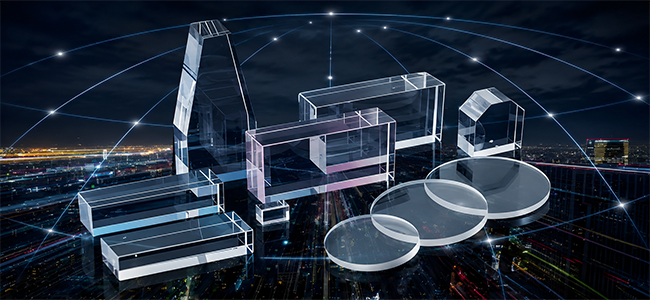
Among many glass materials, BK7 has become a "must-have" because of its excellent overall performance and cost advantage.
1. Broad-spectrum transmission, matching core wavelengths of optical interconnects
BK7's transmission range covers 350nm to 2.0μm, spanning the visible to near-infrared bands. The current mainstream wavelengths for optical modules—850nm, 1310nm, and 1550nm—all fall within BK7's high-transmission range. For optical modules with speeds of 1.6T and above, BK7 windows and lenses can reduce signal loss by more than 30% compared to traditional solutions.
2. Low dispersion, ensuring signal fidelity
BK7 boasts an Abbe number of 64.17, classifying it as a low-dispersion glass. In multi-wavelength parallel transmission optical interconnect scenarios, low dispersion means that light signals of different wavelengths will not be excessively separated after passing through optical components, thus ensuring signal integrity and the signal-to-noise ratio at the receiver.
3. Thermal stability, meeting high-power challenges
The continuously increasing power consumption of AI chips places stringent requirements on the thermal stability of packaging materials. BK7 has a coefficient of thermal expansion of approximately 7.1 × 10⁻⁶/K (-30°C to +70°C). While this differs from that of silicon chips (approximately 2.6 × 10⁻⁶/K), it can still provide reliable performance in multilayer precision optical systems when combined with appropriate stress-buffering structures. More importantly, BK7 has a Young's modulus of 82 GPa and a Knoop hardness of 610, providing robust structural support for precision optical systems.
4. Economy and Availability
Compared to high-end materials such as UV fused silica, BK7 achieves the best balance between cost and performance. In the field of optical modules and optical devices requiring large-scale production, BK7's economic advantages make it the preferred choice for industrial applications. Standardized BK7 windows, lenses, and prisms are available from major global optical component suppliers, indicating a highly mature supply chain.
III. Three Major Application Scenarios of BK7 in AI Optical Interconnection
Scenario 1: Optical Interface of Optical Modules
The BK7 precision window is a standard feature of optical modules. In high-speed optical modules with QSFP-DD and OSFP packages, the BK7 window serves the dual function of sealing protection and optical transmission. Its excellent surface quality (up to 10⁻⁵ scratch-dig) and low wavefront distortion (λ/10 per 25mm) ensure pure laser beam output. For specific wavelengths such as 1064nm, 1310nm, and 1550nm, the BK7 window can be coated with an anti-reflection film, reducing the single-sided reflectivity to below 0.25%.
Scenario 2: Optical Coupling and Collimation System
Within the silicon photonics engine, BK7 plano-convex and plano-concave lenses are used for fiber-to-chip optical coupling. The high transmittance and precision machinability of N-BK7 material in the near-infrared band make it the preferred material for collimators and focusing lenses. With the advancement of co-packaged optics (CPO) technology, precision optical components such as lens arrays will increasingly utilize BK7 or glass materials with equivalent performance.
Scenario 3: Glass Substrate and TGV Interchange Layer
This is the most exciting direction for the BK7 industry chain extension. Through-the-glass via (TBV) technology requires fabricating micron-sized vertical vias on a glass substrate and filling them with copper to achieve electrical interconnection between chips. Although high-end semiconductor packaging glass substrates are still mainly made of specialty glass, BK7, with its mature processing technology and excellent dielectric properties, has already secured a place in the field of glass carriers for optical modules. With the maturation of TGV via technology, yield rates can reach over 99%, and the application boundaries of BK7-type glass materials are continuously expanding.
IV. Industry Chain Structure and Future Outlook
From an industry trend perspective, 2026 to 2030 will be a critical window of opportunity for glass substrates to accelerate their entry into mainstream applications. For BK7 and its related glass materials, the explosive growth of AI optical interconnects signifies a highly certain incremental market. Whether in the optical interfaces of optical modules, the precision coupling systems of CPOs, or in the underlying materials of glass substrates, BK7 will play an irreplaceable role.
Conclusion
The rapid growth of AI optical interconnects is essentially driven by the demand for computing power, which in turn drives the need for physical transmission bandwidth. In this technological race, BK7 glass plates have emerged as the “ideal medium” for bridging the gap between optics and electronics, thanks to their uniformity, thermal stability, broad-spectrum transmittance, and cost advantages. It is neither the most expensive material nor the one with the most extreme performance specifications, but it is the most reliable solution, proven through engineering practice—and this is precisely the quality most valued in industrial mass production.
I. Why is glass indispensable for AI optical interconnection?
To understand the value of BK7, one must first understand the bottlenecks facing AI computing power.
Traditional organic packaging substrates (such as ABF substrates) are essentially composite material systems, made of resin, inorganic fillers, and glass fiber reinforcement layers laminated together. This material is extremely non-uniform at the microscale—the resin absorbs moisture and expands, the glass fiber cloth has directional differences, and the filler distribution cannot be absolutely uniform. When the packaging area of AI chips increases to nearly 6000 square millimeters, these microscopic non-uniformities are amplified geometrically, leading to substrate warping, signal integrity degradation, and ultimately approaching the fault tolerance limits of organic materials.
Glass offers a fundamental solution: uniformity.
Glass is a homogeneous amorphous inorganic material that does not absorb moisture, has no directionality issues, and its composition is highly consistent at both the macroscopic and microscopic scales. This "purity" means highly predictable behavior—the response of the glass substrate is stable and controllable under changes in temperature, humidity, and high-frequency signal transmission. This is precisely the characteristic most desired by AI optical interconnects.
II. BK7: The "Versatile" Choice in the Optical Glass Industry
Among many glass materials, BK7 has become a "must-have" because of its excellent overall performance and cost advantage.
1. Broad-spectrum transmission, matching core wavelengths of optical interconnects
BK7's transmission range covers 350nm to 2.0μm, spanning the visible to near-infrared bands. The current mainstream wavelengths for optical modules—850nm, 1310nm, and 1550nm—all fall within BK7's high-transmission range. For optical modules with speeds of 1.6T and above, BK7 windows and lenses can reduce signal loss by more than 30% compared to traditional solutions.
2. Low dispersion, ensuring signal fidelity
BK7 boasts an Abbe number of 64.17, classifying it as a low-dispersion glass. In multi-wavelength parallel transmission optical interconnect scenarios, low dispersion means that light signals of different wavelengths will not be excessively separated after passing through optical components, thus ensuring signal integrity and the signal-to-noise ratio at the receiver.
3. Thermal stability, meeting high-power challenges
The continuously increasing power consumption of AI chips places stringent requirements on the thermal stability of packaging materials. BK7 has a coefficient of thermal expansion of approximately 7.1 × 10⁻⁶/K (-30°C to +70°C). While this differs from that of silicon chips (approximately 2.6 × 10⁻⁶/K), it can still provide reliable performance in multilayer precision optical systems when combined with appropriate stress-buffering structures. More importantly, BK7 has a Young's modulus of 82 GPa and a Knoop hardness of 610, providing robust structural support for precision optical systems.
4. Economy and Availability
Compared to high-end materials such as UV fused silica, BK7 achieves the best balance between cost and performance. In the field of optical modules and optical devices requiring large-scale production, BK7's economic advantages make it the preferred choice for industrial applications. Standardized BK7 windows, lenses, and prisms are available from major global optical component suppliers, indicating a highly mature supply chain.
III. Three Major Application Scenarios of BK7 in AI Optical Interconnection
Scenario 1: Optical Interface of Optical Modules
The BK7 precision window is a standard feature of optical modules. In high-speed optical modules with QSFP-DD and OSFP packages, the BK7 window serves the dual function of sealing protection and optical transmission. Its excellent surface quality (up to 10⁻⁵ scratch-dig) and low wavefront distortion (λ/10 per 25mm) ensure pure laser beam output. For specific wavelengths such as 1064nm, 1310nm, and 1550nm, the BK7 window can be coated with an anti-reflection film, reducing the single-sided reflectivity to below 0.25%.
Scenario 2: Optical Coupling and Collimation System
Within the silicon photonics engine, BK7 plano-convex and plano-concave lenses are used for fiber-to-chip optical coupling. The high transmittance and precision machinability of N-BK7 material in the near-infrared band make it the preferred material for collimators and focusing lenses. With the advancement of co-packaged optics (CPO) technology, precision optical components such as lens arrays will increasingly utilize BK7 or glass materials with equivalent performance.
Scenario 3: Glass Substrate and TGV Interchange Layer
This is the most exciting direction for the BK7 industry chain extension. Through-the-glass via (TBV) technology requires fabricating micron-sized vertical vias on a glass substrate and filling them with copper to achieve electrical interconnection between chips. Although high-end semiconductor packaging glass substrates are still mainly made of specialty glass, BK7, with its mature processing technology and excellent dielectric properties, has already secured a place in the field of glass carriers for optical modules. With the maturation of TGV via technology, yield rates can reach over 99%, and the application boundaries of BK7-type glass materials are continuously expanding.
IV. Industry Chain Structure and Future Outlook
From an industry trend perspective, 2026 to 2030 will be a critical window of opportunity for glass substrates to accelerate their entry into mainstream applications. For BK7 and its related glass materials, the explosive growth of AI optical interconnects signifies a highly certain incremental market. Whether in the optical interfaces of optical modules, the precision coupling systems of CPOs, or in the underlying materials of glass substrates, BK7 will play an irreplaceable role.
Conclusion
The rapid growth of AI optical interconnects is essentially driven by the demand for computing power, which in turn drives the need for physical transmission bandwidth. In this technological race, BK7 glass plates have emerged as the “ideal medium” for bridging the gap between optics and electronics, thanks to their uniformity, thermal stability, broad-spectrum transmittance, and cost advantages. It is neither the most expensive material nor the one with the most extreme performance specifications, but it is the most reliable solution, proven through engineering practice—and this is precisely the quality most valued in industrial mass production.