From Gaussian to Ring Beam: The 170°Conical Aluminum Mirror Solution
2026-6-17
In laser processing, LiDAR, optical measurement, and related fields, transforming a standard circular Gaussian beam into a uniformly distributed ring-shaped beam is a classic and important engineering challenge. Conventional approaches often rely on axicons, diffractive optical elements, or spatial light modulators, but these solutions suffer from high cost, sensitivity to alignment, and limited damage thresholds.
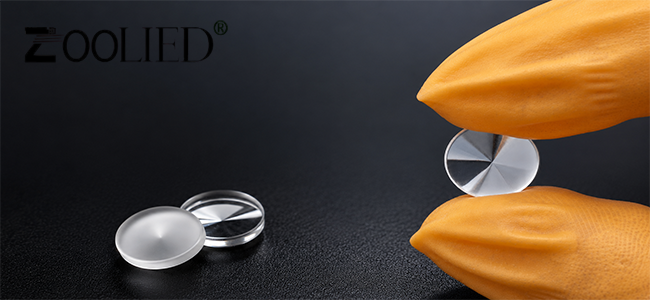
An increasingly attractive alternative is the 170° Conical Aluminum Mirror—a simpler and more cost-effective device.
1. Why 170°?
A basic geometrical-optical relationship must first be understood.
For a conical mirror with apex angle θ, when a collimated beam travels along the axis, reflection from the conical surface produces a ring beam. The divergence half-angle of the ring is directly related to the cone angle:
At θ = 180°, the cone degenerates into a flat mirror; the reflected beam remains collimated and no ring is formed.
For θ < 180°, the reflected light is deflected either outward or inward, depending on the geometry of the incident and reflecting surfaces.
For a 170° cone (i.e., the cone surface makes only a 5° angle with the symmetry axis), an incident collimated beam yields a ring beam that diverges outward at a small angle. Its notable features include:
Thin ring wall: The radial thickness of the ring is approximately equal to the incident beam diameter.
Controllable ring diameter: By adjusting the distance between the cone mirror and the target plane, the ring diameter can be varied linearly.
Uniform energy distribution: This is a fundamental difference between conical reflection and planar reflection.
Unlike axicons, the conical mirror works by reflection rather than transmission. This difference brings two immediate advantages:
(1) it can be used in high-power laser systems (avoiding absorption and thermal lensing in transmissive materials),
(2) aluminum coatings maintain high reflectivity over a broad spectral range (from UV to IR).
2. What Happens in Transforming a Gaussian Beam into a Ring Beam?
A typical laser output has a Gaussian profile—high intensity at the center and low intensity at the edges. While this distribution is desirable for some applications (e.g., laser cutting), in areas such as laser heat treatment, ring-beam LiDAR, and laser drilling, it is often preferable to concentrate the energy into a ring while keeping the central region as low as possible.
With a 170° conical mirror, the beam-shaping process can be summarized in three steps:
Collimated parallel light incidence: The laser beam is expanded and collimated, then directed along the cone axis toward the bottom region of the cone.
Conical surface unfolding: Rays reflect off the conical surface; rays at different radial positions are redirected to different azimuthal angles, forming a continuous ring.
Uniform ring in the far field: At a sufficiently distant observation plane, the energy from the original Gaussian beam is "stretched" and spread uniformly over the entire ring area.
Measured result: Using a Φ25 mm, 170° K9 glass conical mirror with aluminum coating (632.8 nm He-Ne laser, collimated, beam diameter 8 mm), the ring obtained at 1 m distance had a ring width of ~8 mm and ring diameter of ~175 mm, with in-ring nonuniformity controlled within ±15%—a typical direct-output performance without additional modulation.
3. Application Scenarios
The simple 170° conical mirror solution has been validated in several fields:
LiDAR transmitter: Distributes laser energy over a ring area to enable circumferential scanning of the surrounding environment, leaving the central blind zone naturally available for the receiving optics.
Laser heat treatment: Provides uniform heating of annular workpieces such as pipes and bearings, avoiding center overheating.
Machine-vision ring illumination: Used with coaxial optics to deliver shadow-free illumination for highly reflective or deep-hole parts.
Optical calibration: Generates ring patterns of known dimensions for camera distortion calibration or measurement-system linewidth verification.
4. Two Key Reminders for Selection
If you are considering using a 170° conical mirror in a practical project, keep these two points in mind:
Actual impact of cone-angle accuracy
170° is a nominal value. A deviation of ±0.1° can cause approximately 5% variation in ring diameter. For systems requiring high ring-diameter precision (e.g., precision measurement), request the supplier to provide measured angle data (using coordinate measuring machines or interferometric methods).
Practical considerations for aluminum coating protection
Standard protected aluminum coatings offer reflectivity of ~90–94% in the visible band. For high-humidity or corrosive environments, explicitly specify ion-assisted deposition with an SiO₂ protective layer (80–120 nm thick) and request aging test data. For UV operation (<350 nm), use UV-enhanced aluminum coatings (with MgF₂ overcoat).
5. Conclusion
Optical system design often follows a simple principle: use reflection wherever possible instead of transmission; use a single element wherever possible instead of multiple elements. The 170° cone-angle aluminum-coated mirror is a typical embodiment of this principle—achieving Gaussian-to-ring conversion with one element, one reflection, and one aluminum coating.
It may not be the optimal solution for every scenario, but its simplicity, high-power tolerance, and broad spectral compatibility make it an option that should not be overlooked in the beam-shaping toolbox.
Zoolied offers H-K9L substrates, Φ10–50 mm, cone angle 170° ±0.05°, with protected aluminum coating on the conical surface. Custom cylinder height and chamfer dimensions are available. For sample testing or technical selection consultation, please contact us.
An increasingly attractive alternative is the 170° Conical Aluminum Mirror—a simpler and more cost-effective device.
1. Why 170°?
A basic geometrical-optical relationship must first be understood.
For a conical mirror with apex angle θ, when a collimated beam travels along the axis, reflection from the conical surface produces a ring beam. The divergence half-angle of the ring is directly related to the cone angle:
At θ = 180°, the cone degenerates into a flat mirror; the reflected beam remains collimated and no ring is formed.
For θ < 180°, the reflected light is deflected either outward or inward, depending on the geometry of the incident and reflecting surfaces.
For a 170° cone (i.e., the cone surface makes only a 5° angle with the symmetry axis), an incident collimated beam yields a ring beam that diverges outward at a small angle. Its notable features include:
Thin ring wall: The radial thickness of the ring is approximately equal to the incident beam diameter.
Controllable ring diameter: By adjusting the distance between the cone mirror and the target plane, the ring diameter can be varied linearly.
Uniform energy distribution: This is a fundamental difference between conical reflection and planar reflection.
Unlike axicons, the conical mirror works by reflection rather than transmission. This difference brings two immediate advantages:
(1) it can be used in high-power laser systems (avoiding absorption and thermal lensing in transmissive materials),
(2) aluminum coatings maintain high reflectivity over a broad spectral range (from UV to IR).
2. What Happens in Transforming a Gaussian Beam into a Ring Beam?
A typical laser output has a Gaussian profile—high intensity at the center and low intensity at the edges. While this distribution is desirable for some applications (e.g., laser cutting), in areas such as laser heat treatment, ring-beam LiDAR, and laser drilling, it is often preferable to concentrate the energy into a ring while keeping the central region as low as possible.
With a 170° conical mirror, the beam-shaping process can be summarized in three steps:
Collimated parallel light incidence: The laser beam is expanded and collimated, then directed along the cone axis toward the bottom region of the cone.
Conical surface unfolding: Rays reflect off the conical surface; rays at different radial positions are redirected to different azimuthal angles, forming a continuous ring.
Uniform ring in the far field: At a sufficiently distant observation plane, the energy from the original Gaussian beam is "stretched" and spread uniformly over the entire ring area.
Measured result: Using a Φ25 mm, 170° K9 glass conical mirror with aluminum coating (632.8 nm He-Ne laser, collimated, beam diameter 8 mm), the ring obtained at 1 m distance had a ring width of ~8 mm and ring diameter of ~175 mm, with in-ring nonuniformity controlled within ±15%—a typical direct-output performance without additional modulation.
3. Application Scenarios
The simple 170° conical mirror solution has been validated in several fields:
LiDAR transmitter: Distributes laser energy over a ring area to enable circumferential scanning of the surrounding environment, leaving the central blind zone naturally available for the receiving optics.
Laser heat treatment: Provides uniform heating of annular workpieces such as pipes and bearings, avoiding center overheating.
Machine-vision ring illumination: Used with coaxial optics to deliver shadow-free illumination for highly reflective or deep-hole parts.
Optical calibration: Generates ring patterns of known dimensions for camera distortion calibration or measurement-system linewidth verification.
4. Two Key Reminders for Selection
If you are considering using a 170° conical mirror in a practical project, keep these two points in mind:
Actual impact of cone-angle accuracy
170° is a nominal value. A deviation of ±0.1° can cause approximately 5% variation in ring diameter. For systems requiring high ring-diameter precision (e.g., precision measurement), request the supplier to provide measured angle data (using coordinate measuring machines or interferometric methods).
Practical considerations for aluminum coating protection
Standard protected aluminum coatings offer reflectivity of ~90–94% in the visible band. For high-humidity or corrosive environments, explicitly specify ion-assisted deposition with an SiO₂ protective layer (80–120 nm thick) and request aging test data. For UV operation (<350 nm), use UV-enhanced aluminum coatings (with MgF₂ overcoat).
5. Conclusion
Optical system design often follows a simple principle: use reflection wherever possible instead of transmission; use a single element wherever possible instead of multiple elements. The 170° cone-angle aluminum-coated mirror is a typical embodiment of this principle—achieving Gaussian-to-ring conversion with one element, one reflection, and one aluminum coating.
It may not be the optimal solution for every scenario, but its simplicity, high-power tolerance, and broad spectral compatibility make it an option that should not be overlooked in the beam-shaping toolbox.
Zoolied offers H-K9L substrates, Φ10–50 mm, cone angle 170° ±0.05°, with protected aluminum coating on the conical surface. Custom cylinder height and chamfer dimensions are available. For sample testing or technical selection consultation, please contact us.