Using a Right-Angle Prism for TIR? Master These 3 Physical Details First
2026-7-20
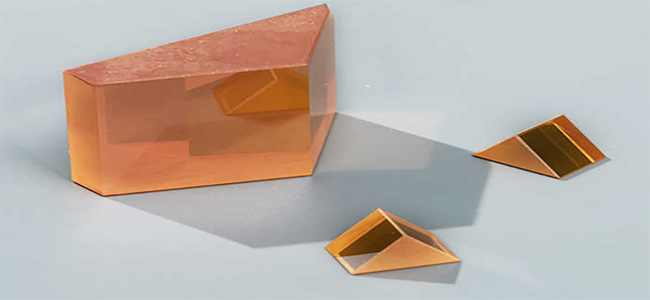
In optical design, the right-angle prism is a component that appears simple yet is remarkably sophisticated. It leverages the principle of total internal reflection (TIR) to achieve optical path folding with extremely low loss — a characteristic that makes it an "upgraded alternative" to conventional mirrors. However, to truly harness the full potential of a right-angle prism, several critical physical details must be thoroughly understood.
Detail 1: 90° Folding vs. 180° Retroreflection — It All Depends on Which Face the Light Enters
The most fundamental function of a right-angle prism is to deviate the optical path by 90° or 180°. Which function is achieved depends entirely on the choice of the entrance face.
When used as a 90° folding mirror, light enters through one right-angle face, undergoes a single total internal reflection at the glass/air interface of the hypotenuse, and exits through the other right-angle face. This effectively replaces a plane mirror with a prism, yet achieves a theoretical reflectivity of 100% (excluding minor transmission losses at the entrance and exit surfaces).
When used as a 180° retroreflector, light enters through the hypotenuse, undergoes total internal reflection on each of the two right-angle faces, and exits through the hypotenuse in a direction parallel to the incident beam. More importantly, this 180° deviation is independent of the incident angle — even if the incoming beam direction shifts slightly, the outgoing beam remains anti-parallel. This property is particularly useful in systems that require the optical path to "return along the same route."
Detail 2: The High Efficiency of TIR Comes with a Strict Critical Angle Constraint
Total internal reflection sounds ideal — a theoretical reflectivity of 100%, far surpassing any metallic coated mirror. However, this comes with a prerequisite: the incident angle must exceed the critical angle at the material-air interface.
For common N-BK7 glass (refractive index ~1.52), the critical angle is approximately 41°. The geometric design of a right-angle prism leverages exactly this condition — at a 45° incidence angle on the hypotenuse, the light inherently satisfies the TIR condition at the glass-air interface. However, if the prism mounting angle deviates, or if the incident beam is not perpendicular to the entrance face, the TIR condition may be broken, causing partial energy to "leak" out and the reflectivity to drop sharply.
For infrared materials such as multispectral zinc sulfide (ZnS MS), which has a refractive index of approximately 2.37 (at 10.6 μm), the critical angle is lower (about 25°), making TIR easier to achieve. Nevertheless, the angular margin must still be considered in the design, especially in broadband or multi-angle systems.
Detail 3: The Polarization State of the Beam Is Altered by Total Internal Reflection
This is a point often overlooked by many engineers: total internal reflection induces a change in the polarization state of the incident beam.
When light undergoes TIR at an interface, the phase shifts for s-polarization and p-polarization differ. This difference causes linearly polarized light to become elliptically polarized. For most imaging or illumination applications, this effect may be negligible; however, in interferometry, polarization imaging, or laser systems, it can introduce non-negligible errors.
If polarization preservation is required while utilizing TIR, phase-compensation coatings can be applied to the hypotenuse of the prism. Alternatively, the prism can be coated with a metallic reflective coating to replace TIR — but in this case, the reflectivity will drop from 100% to around 90% or higher, depending on the coating quality.
Summary
The application of total internal reflection in a right-angle prism may appear to be a simple combination of a "45° angle plus a glass/air interface." However, it involves three critical physical details: optical path geometry, critical angle constraints, and polarization effects. Only by fully understanding these details at the design stage can this seemingly fundamental optical component truly deliver its performance advantages.
If you require a right-angle prism for infrared applications, multispectral zinc sulfide (ZnS MS) — with its low absorption across the broad visible-to-IR band (0.4–12 μm) — is an ideal choice that accommodates both visible alignment and infrared imaging.
Detail 1: 90° Folding vs. 180° Retroreflection — It All Depends on Which Face the Light Enters
The most fundamental function of a right-angle prism is to deviate the optical path by 90° or 180°. Which function is achieved depends entirely on the choice of the entrance face.
When used as a 90° folding mirror, light enters through one right-angle face, undergoes a single total internal reflection at the glass/air interface of the hypotenuse, and exits through the other right-angle face. This effectively replaces a plane mirror with a prism, yet achieves a theoretical reflectivity of 100% (excluding minor transmission losses at the entrance and exit surfaces).
When used as a 180° retroreflector, light enters through the hypotenuse, undergoes total internal reflection on each of the two right-angle faces, and exits through the hypotenuse in a direction parallel to the incident beam. More importantly, this 180° deviation is independent of the incident angle — even if the incoming beam direction shifts slightly, the outgoing beam remains anti-parallel. This property is particularly useful in systems that require the optical path to "return along the same route."
Detail 2: The High Efficiency of TIR Comes with a Strict Critical Angle Constraint
Total internal reflection sounds ideal — a theoretical reflectivity of 100%, far surpassing any metallic coated mirror. However, this comes with a prerequisite: the incident angle must exceed the critical angle at the material-air interface.
For common N-BK7 glass (refractive index ~1.52), the critical angle is approximately 41°. The geometric design of a right-angle prism leverages exactly this condition — at a 45° incidence angle on the hypotenuse, the light inherently satisfies the TIR condition at the glass-air interface. However, if the prism mounting angle deviates, or if the incident beam is not perpendicular to the entrance face, the TIR condition may be broken, causing partial energy to "leak" out and the reflectivity to drop sharply.
For infrared materials such as multispectral zinc sulfide (ZnS MS), which has a refractive index of approximately 2.37 (at 10.6 μm), the critical angle is lower (about 25°), making TIR easier to achieve. Nevertheless, the angular margin must still be considered in the design, especially in broadband or multi-angle systems.
Detail 3: The Polarization State of the Beam Is Altered by Total Internal Reflection
This is a point often overlooked by many engineers: total internal reflection induces a change in the polarization state of the incident beam.
When light undergoes TIR at an interface, the phase shifts for s-polarization and p-polarization differ. This difference causes linearly polarized light to become elliptically polarized. For most imaging or illumination applications, this effect may be negligible; however, in interferometry, polarization imaging, or laser systems, it can introduce non-negligible errors.
If polarization preservation is required while utilizing TIR, phase-compensation coatings can be applied to the hypotenuse of the prism. Alternatively, the prism can be coated with a metallic reflective coating to replace TIR — but in this case, the reflectivity will drop from 100% to around 90% or higher, depending on the coating quality.
Summary
The application of total internal reflection in a right-angle prism may appear to be a simple combination of a "45° angle plus a glass/air interface." However, it involves three critical physical details: optical path geometry, critical angle constraints, and polarization effects. Only by fully understanding these details at the design stage can this seemingly fundamental optical component truly deliver its performance advantages.
If you require a right-angle prism for infrared applications, multispectral zinc sulfide (ZnS MS) — with its low absorption across the broad visible-to-IR band (0.4–12 μm) — is an ideal choice that accommodates both visible alignment and infrared imaging.