Optical Rod Lenses: Design Evolution and Application Frontiers
2026-7-27
Optical Rod Lens is a special optical component with a cylindrical shape and polished end faces. Unlike traditional lenses, it utilizes refraction within the cylindrical medium or an internal gradient refractive index (GRIN) distribution to achieve special beam control—either focusing light into a high-energy-density line or enabling long-distance image transmission in confined spaces. Rod lenses are playing an increasingly critical role in precision optics, medical imaging, laser processing, and other fields.
1. What is an Optical Rod Lens
An optical rod lens is essentially a special cylindrical optical component. Its lateral surface is highly polished, and both end faces are ground, giving it an appearance similar to a slender glass rod. After light enters the rod lens, beam shaping and transmission are achieved through refraction and reflection paths within the cylindrical medium.
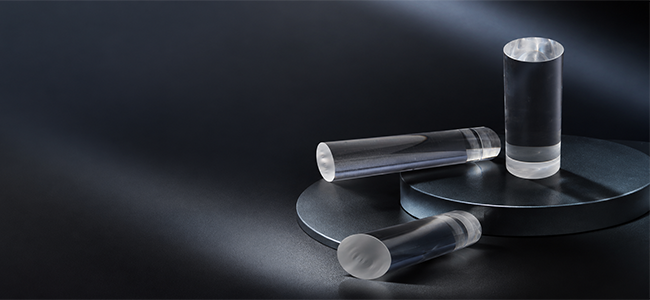
From the perspective of materials, common optical rod lenses are primarily manufactured from H-K9L optical glass, F2 glass, and UV-grade fused silica, among other materials, allowing selection based on the operating wavelength band and transmittance requirements. In the visible light band, H-K9L is the general-purpose choice; whereas in UV or high-power laser applications, UV-grade fused silica becomes the preferred option due to its low coefficient of thermal expansion and high transmittance.
In terms of precision, the diameter tolerance of high-performance rod lenses can be controlled within ±0.02 mm, with surface quality reaching 20/10 (scratch/dig) and surface accuracy achieving λ/6 @ 633 nm. Some high-precision products can even attain extreme levels of diameter tolerance within ±0.0075 mm and surface quality of 10/5. These specifications indicate that the surface smoothness and dimensional consistency of rod lenses have reached the level of ultra-precision optics.
2. Working Principles: Refractive Imaging and Gradient Index
The working mechanisms of rod lenses are mainly divided into two types.
The first is the traditional refractive rod lens. Light enters the cylindrical medium through the end face of the rod lens, propagates in a straight line within the cylinder, and exits from the other end face. Its optical behavior is similar to that of a cylindrical lens, capable of focusing a collimated beam into a straight line rather than a single spot. This characteristic holds unique value in applications such as laser line scanning and barcode reading.
The second is the gradient-index (GRIN) rod lens. In this type of rod lens, the refractive index decreases in a gradient from the center toward the periphery. Light propagates along smooth curved paths within it, achieving focusing or collimation effects similar to those of conventional lenses, yet without the need for curved surfaces. This design enables the rod lens to maintain flat end faces while possessing focusing capability, greatly simplifying the assembly process.
3.Core Medical Application: Rigid Endoscopes
The most classic and technologically demanding application of rod lenses is in the relay imaging system of rigid endoscopes.
The relay system of traditional rigid endoscopes consists of multiple thin lenses arranged in sequence, which suffers from poor optical axis alignment and low light transmission efficiency. The advent of the Hopkins rod lens completely transformed this landscape. This type of rod lens has a relatively long length and can achieve a relative aperture of up to 1:6, increasing light transmission capability by 9 to 11 times compared to traditional designs. Meanwhile, due to the symmetrical structure of the relay system, no lateral aberration is generated. Spherical aberration and chromatic aberration can be independently corrected by cemented negative lenses, while astigmatism is corrected by varying the spacing between rod lens groups.
The following table compares the key differences between the traditional thin-lens relay system and the rod-lens relay system:
In the field of ultra-thin endoscopes, the value of rod lenses becomes even more prominent. A study published in Applied Optics demonstrated an ultra-thin rod lens design with a clear aperture of only 0.8 mm and a single lens length of less than 6 mm—the entire system consisting of an objective lens, five rod lens groups, and an eyepiece, with a working length of 121 mm and an image-space resolution of 113.5 lp/mm, reaching the diffraction limit. Notably, the design employs spherical surfaces rather than aspherical ones, effectively controlling manufacturing cost and difficulty.
However, the design of ultra-thin rod lenses faces a core dilemma: the more rod lens groups there are, the more spherical aberration, field curvature, and axial errors multiply, and assembly errors accumulate accordingly. To address this, researchers have proposed a four-cemented Hopkins rod lens solution: by further optimizing the three-cemented rod lens into a four-cemented structure, field curvature is corrected within the rod lens system itself rather than relying on eyepiece compensation, greatly facilitating subsequent system design.
At the manufacturing level, traditional Hopkins rod lens systems employ symmetrical cemented lens structures, but small-diameter cementing is difficult and costly. To address this challenge, recent technical approaches have abandoned cemented lenses in favor of mutually supporting lenses. By optimizing lens surface curvature to achieve zero air-spacing between groups, these designs maintain the effective clear aperture while avoiding the difficulties associated with cementing processes. This approach also enables endoscopes using such rod lenses to withstand high-temperature, high-pressure sterilization, which is of great clinical significance.
4. Other Typical Application Scenarios
Laser Processing and Beam Shaping. In laser cutting and welding applications, rod lenses can focus a laser beam into a straight line with high energy density and excellent linearity, enabling more efficient line-scanning processing compared to traditional point focusing.
Rod Lens Array. By arranging multiple rod lenses in an array at specific spacing, equal-magnification imaging of the original image can be achieved. This is commonly used in the optical systems of scanners, copiers, and similar devices, serving as a core component for device miniaturization.
Optical Communications and Precision Measurement. Rod lenses utilize the principle of total internal reflection to transmit light within the rod, or serve as light homogenizing rods to integrate non-uniform light spots into a uniform line light source. They find applications in optical communication devices and optical measurement instruments.
5. Technology Development Trends
Current optical rod lens technology is evolving in three directions: higher precision, smaller dimensions, and lower cost.
In terms of precision, diameter tolerance of ±0.02 mm and surface quality of 20/10 have become standard specifications for high-precision products, while some high-end applications have already advanced to the level of ±0.0075 mm diameter tolerance and 10/5 surface quality. In terms of size, ultra-thin rod lenses with a clear aperture of 0.8 mm have been successfully validated in prototype systems, replacing expensive image-transmitting fiber bundles that suffer from Moiré pattern defects, while achieving higher resolution. On the manufacturing front, design approaches that abandon cementing in favor of mutually supporting lenses are breaking through the limitations of traditional processes, enabling high-performance rod lenses to be mass-producible while maintaining cost control.
From the material perspective, H-K9L optical glass and UV-grade fused silica represent the two mainstream directions, corresponding respectively to visible/near-infrared applications and ultraviolet/high-power laser applications.
1. What is an Optical Rod Lens
An optical rod lens is essentially a special cylindrical optical component. Its lateral surface is highly polished, and both end faces are ground, giving it an appearance similar to a slender glass rod. After light enters the rod lens, beam shaping and transmission are achieved through refraction and reflection paths within the cylindrical medium.
From the perspective of materials, common optical rod lenses are primarily manufactured from H-K9L optical glass, F2 glass, and UV-grade fused silica, among other materials, allowing selection based on the operating wavelength band and transmittance requirements. In the visible light band, H-K9L is the general-purpose choice; whereas in UV or high-power laser applications, UV-grade fused silica becomes the preferred option due to its low coefficient of thermal expansion and high transmittance.
In terms of precision, the diameter tolerance of high-performance rod lenses can be controlled within ±0.02 mm, with surface quality reaching 20/10 (scratch/dig) and surface accuracy achieving λ/6 @ 633 nm. Some high-precision products can even attain extreme levels of diameter tolerance within ±0.0075 mm and surface quality of 10/5. These specifications indicate that the surface smoothness and dimensional consistency of rod lenses have reached the level of ultra-precision optics.
2. Working Principles: Refractive Imaging and Gradient Index
The working mechanisms of rod lenses are mainly divided into two types.
The first is the traditional refractive rod lens. Light enters the cylindrical medium through the end face of the rod lens, propagates in a straight line within the cylinder, and exits from the other end face. Its optical behavior is similar to that of a cylindrical lens, capable of focusing a collimated beam into a straight line rather than a single spot. This characteristic holds unique value in applications such as laser line scanning and barcode reading.
The second is the gradient-index (GRIN) rod lens. In this type of rod lens, the refractive index decreases in a gradient from the center toward the periphery. Light propagates along smooth curved paths within it, achieving focusing or collimation effects similar to those of conventional lenses, yet without the need for curved surfaces. This design enables the rod lens to maintain flat end faces while possessing focusing capability, greatly simplifying the assembly process.
|
Type |
Principle |
Core Advantages |
Typical Applications |
|
Refractive Rod Lens |
Light propagates in a straight line within the cylindrical medium |
Simple structure, easy to manufacture |
Laser line scanning, barcode reading |
|
GRIN Rod Lens |
Refractive index decreases in a gradient from center to periphery |
Flat end-face focusing, easy assembly |
Miniature imaging systems, fiber coupling |
3.Core Medical Application: Rigid Endoscopes
The most classic and technologically demanding application of rod lenses is in the relay imaging system of rigid endoscopes.
The relay system of traditional rigid endoscopes consists of multiple thin lenses arranged in sequence, which suffers from poor optical axis alignment and low light transmission efficiency. The advent of the Hopkins rod lens completely transformed this landscape. This type of rod lens has a relatively long length and can achieve a relative aperture of up to 1:6, increasing light transmission capability by 9 to 11 times compared to traditional designs. Meanwhile, due to the symmetrical structure of the relay system, no lateral aberration is generated. Spherical aberration and chromatic aberration can be independently corrected by cemented negative lenses, while astigmatism is corrected by varying the spacing between rod lens groups.
The following table compares the key differences between the traditional thin-lens relay system and the rod-lens relay system:
|
Comparison Dimension |
Traditional Thin-Lens Relay System |
Rod Lens Relay System |
|
Light Transmission Efficiency |
Baseline value |
9–11× improvement |
|
Optical Axis Alignment |
Poor, cumulative error from lens to lens |
Excellent, structurally stable as an integrated unit |
|
Lateral Aberration |
Present |
None due to symmetric structure |
|
Assembly Complexity |
High, sequential alignment of multiple lenses |
Low, assembled as an integrated component |
In the field of ultra-thin endoscopes, the value of rod lenses becomes even more prominent. A study published in Applied Optics demonstrated an ultra-thin rod lens design with a clear aperture of only 0.8 mm and a single lens length of less than 6 mm—the entire system consisting of an objective lens, five rod lens groups, and an eyepiece, with a working length of 121 mm and an image-space resolution of 113.5 lp/mm, reaching the diffraction limit. Notably, the design employs spherical surfaces rather than aspherical ones, effectively controlling manufacturing cost and difficulty.
However, the design of ultra-thin rod lenses faces a core dilemma: the more rod lens groups there are, the more spherical aberration, field curvature, and axial errors multiply, and assembly errors accumulate accordingly. To address this, researchers have proposed a four-cemented Hopkins rod lens solution: by further optimizing the three-cemented rod lens into a four-cemented structure, field curvature is corrected within the rod lens system itself rather than relying on eyepiece compensation, greatly facilitating subsequent system design.
At the manufacturing level, traditional Hopkins rod lens systems employ symmetrical cemented lens structures, but small-diameter cementing is difficult and costly. To address this challenge, recent technical approaches have abandoned cemented lenses in favor of mutually supporting lenses. By optimizing lens surface curvature to achieve zero air-spacing between groups, these designs maintain the effective clear aperture while avoiding the difficulties associated with cementing processes. This approach also enables endoscopes using such rod lenses to withstand high-temperature, high-pressure sterilization, which is of great clinical significance.
4. Other Typical Application Scenarios
Laser Processing and Beam Shaping. In laser cutting and welding applications, rod lenses can focus a laser beam into a straight line with high energy density and excellent linearity, enabling more efficient line-scanning processing compared to traditional point focusing.
Rod Lens Array. By arranging multiple rod lenses in an array at specific spacing, equal-magnification imaging of the original image can be achieved. This is commonly used in the optical systems of scanners, copiers, and similar devices, serving as a core component for device miniaturization.
Optical Communications and Precision Measurement. Rod lenses utilize the principle of total internal reflection to transmit light within the rod, or serve as light homogenizing rods to integrate non-uniform light spots into a uniform line light source. They find applications in optical communication devices and optical measurement instruments.
|
Application Field |
Function |
Advantages |
|
Rigid Endoscopes |
Relay imaging |
High light transmission efficiency, excellent aberration control, sterilizable at high temperature |
|
Laser Processing |
Beam shaping into a line spot |
Straight line profile, high energy density |
|
Rod Lens Array |
Equal-magnification imaging |
Miniaturization, suitable for scanning/copying equipment |
|
Optical Communications & Precision Measurement |
Light homogenization / light transmission |
Low-loss total internal reflection, excellent uniformity |
5. Technology Development Trends
Current optical rod lens technology is evolving in three directions: higher precision, smaller dimensions, and lower cost.
In terms of precision, diameter tolerance of ±0.02 mm and surface quality of 20/10 have become standard specifications for high-precision products, while some high-end applications have already advanced to the level of ±0.0075 mm diameter tolerance and 10/5 surface quality. In terms of size, ultra-thin rod lenses with a clear aperture of 0.8 mm have been successfully validated in prototype systems, replacing expensive image-transmitting fiber bundles that suffer from Moiré pattern defects, while achieving higher resolution. On the manufacturing front, design approaches that abandon cementing in favor of mutually supporting lenses are breaking through the limitations of traditional processes, enabling high-performance rod lenses to be mass-producible while maintaining cost control.
From the material perspective, H-K9L optical glass and UV-grade fused silica represent the two mainstream directions, corresponding respectively to visible/near-infrared applications and ultraviolet/high-power laser applications.