The Key Considerations for Selecting Optical Dome
2026-3-19
As a core protective component in optical detection and imaging systems, optical domes combine light transmission, sealing, and pressure resistance. When selecting a dome, it is essential to consider optical performance, mechanical strength, environmental compatibility, and installation precision to avoid imaging distortion, light transmission loss, or structural failure caused by parameter mismatches. This article outlines a standardized selection approach from a core technical perspective to facilitate precise matching with specific application scenarios.
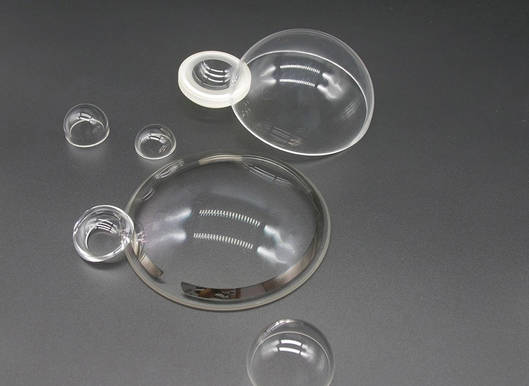
I. Matching Optical Bands and Selecting Substrate Types
The substrate is the key factor determining light transmittance and must be selected to align with the system’s operating wavelength range. For visible light applications, BK7 optical glass is the preferred choice, offering transmittance exceeding 90% in the 300 nm–2 μm range, moderate cost, and ease of achieving high machining precision. For ultraviolet detection, UV-grade fused quartz is recommended, as it covers short-wavelength UV down to 185 nm and is resistant to UV aging without yellowing. For infrared thermal imaging and laser detection applications, prioritize infrared substrates such as sapphire, germanium, and zinc sulfide, which balance infrared transmittance with surface hardness. Additionally, verify refractive index compatibility to prevent aberrations caused by excessive refractive index differences between the dome and the optical system, thereby ensuring image clarity.
II. Strictly Control Structural Precision to Eliminate Optical Distortion
The concentricity and uniform thickness of the dome directly affect the stability of the optical path. For high-precision applications, the following requirements must be met: concentricity error between the inner and outer spherical surfaces ≤ 0.02 mm, and thickness tolerance controlled within ±0.05 mm, to prevent light deflection and blurred imaging caused by localized thickness variations. The aperture must be adapted to the detector’s field of view. Hemispherical domes enable wide-angle detection without blind spots, making them suitable for PTZ cameras and panoramic detection equipment. Wall thickness must also be carefully considered: insufficient thickness can lead to structural failure under pressure, while excessive thickness increases light absorption and loss. A balance must be struck between structural strength and light transmittance.
III. Adapting to Operating Conditions and Enhancing Protective Performance
In harsh environments such as outdoor, underwater, and aerospace applications, mechanical properties and weather resistance must be prioritized. For outdoor applications requiring dust and scratch resistance, sapphire substrates with a Mohs hardness of ≥9 should be selected. For underwater and high-pressure environments, compressive strength must be evaluated, and high-strength materials such as fused quartz should be selected in conjunction with a sealed structural design. For environments with alternating high and low temperatures, substrates with low thermal expansion coefficients are preferred to prevent cracking and sudden drops in light transmittance caused by temperature differences. It is recommended to pair these with anti-reflective (AR) coatings, which can reduce surface reflectance to below 1% in the visible light spectrum, significantly increasing light transmission.
IV. Matching Installation Interfaces to Ensure Long-Term Reliability
During the final stages of selection, verify installation dimensions and sealing methods. The edge processing of the dome must be compatible with the flange clamping structure to ensure a leak-free seal. For mass production, ensure manufacturing consistency to prevent individual part tolerances from affecting system compatibility.
In summary, the selection of optical domes should follow the logic of “selecting the substrate based on the wavelength band, controlling the structure for precision, choosing protection based on operating conditions, and ensuring a proper fit at the installation interface.” This approach balances optical performance with engineering practicality to achieve optimal results in both protection and imaging.
The substrate is the key factor determining light transmittance and must be selected to align with the system’s operating wavelength range. For visible light applications, BK7 optical glass is the preferred choice, offering transmittance exceeding 90% in the 300 nm–2 μm range, moderate cost, and ease of achieving high machining precision. For ultraviolet detection, UV-grade fused quartz is recommended, as it covers short-wavelength UV down to 185 nm and is resistant to UV aging without yellowing. For infrared thermal imaging and laser detection applications, prioritize infrared substrates such as sapphire, germanium, and zinc sulfide, which balance infrared transmittance with surface hardness. Additionally, verify refractive index compatibility to prevent aberrations caused by excessive refractive index differences between the dome and the optical system, thereby ensuring image clarity.
II. Strictly Control Structural Precision to Eliminate Optical Distortion
The concentricity and uniform thickness of the dome directly affect the stability of the optical path. For high-precision applications, the following requirements must be met: concentricity error between the inner and outer spherical surfaces ≤ 0.02 mm, and thickness tolerance controlled within ±0.05 mm, to prevent light deflection and blurred imaging caused by localized thickness variations. The aperture must be adapted to the detector’s field of view. Hemispherical domes enable wide-angle detection without blind spots, making them suitable for PTZ cameras and panoramic detection equipment. Wall thickness must also be carefully considered: insufficient thickness can lead to structural failure under pressure, while excessive thickness increases light absorption and loss. A balance must be struck between structural strength and light transmittance.
III. Adapting to Operating Conditions and Enhancing Protective Performance
In harsh environments such as outdoor, underwater, and aerospace applications, mechanical properties and weather resistance must be prioritized. For outdoor applications requiring dust and scratch resistance, sapphire substrates with a Mohs hardness of ≥9 should be selected. For underwater and high-pressure environments, compressive strength must be evaluated, and high-strength materials such as fused quartz should be selected in conjunction with a sealed structural design. For environments with alternating high and low temperatures, substrates with low thermal expansion coefficients are preferred to prevent cracking and sudden drops in light transmittance caused by temperature differences. It is recommended to pair these with anti-reflective (AR) coatings, which can reduce surface reflectance to below 1% in the visible light spectrum, significantly increasing light transmission.
IV. Matching Installation Interfaces to Ensure Long-Term Reliability
During the final stages of selection, verify installation dimensions and sealing methods. The edge processing of the dome must be compatible with the flange clamping structure to ensure a leak-free seal. For mass production, ensure manufacturing consistency to prevent individual part tolerances from affecting system compatibility.
In summary, the selection of optical domes should follow the logic of “selecting the substrate based on the wavelength band, controlling the structure for precision, choosing protection based on operating conditions, and ensuring a proper fit at the installation interface.” This approach balances optical performance with engineering practicality to achieve optimal results in both protection and imaging.