Sapphire: the ‘transparent armour’ of the optical world
2026-3-26
When sapphire is mentioned, most people think of that deep blue hue found in jewellery. However, in the eyes of materials scientists, the true value of this single crystal of α-alumina (chemical formula Al₂O₃) lies in its ‘hardcore’ optical properties—its physical characteristics, including a Mohs hardness of 9 (second only to diamond), enable it to withstand abrasion from sand and dust; a broad transmission range of 0.15–5.5 micrometres covering the ultraviolet to mid-infrared spectrum; and a thermal conductivity of up to 2000 W/m·K, combined with a thermal expansion coefficient of 17×10⁻⁶/°C, resulting in exceptional thermal shock resistance. These characteristics have taken it from the jewellery counter into the laboratory, where it serves as the ‘invisible guardian’ of optical components.
I. The Three Major Optical ‘Superpowers’ of Sapphire
The ‘Transparent Guardian’ in Extreme Environments
Sapphire can withstand temperatures of up to 2,000°C without losing its transparency, and its thermal stability far exceeds that of ordinary optical glass. NASA uses it as a material for space shuttle windows, where it can withstand plasma erosion at temperatures of 1,650°C during atmospheric re-entry. The laser rangefinder on China’s Chang’e-5 mission utilises sapphire lenses; despite temperature fluctuations of 300°C between day and night on the Moon, the change in its refractive index does not exceed 0.001%, ensuring millimetre-level ranging accuracy.
The ‘energy conduit’ of the laser
High-purity sapphire (impurity content < 10 ppm) grown by the zone-melting method possesses a hexagonal crystal structure that provides perfect lattice matching for Nd:YAG lasers. In the industrial sector, German multi-kilowatt fibre laser cutting machines utilise sapphire output mirrors, enabling continuous operation for 8,000 hours without the occurrence of thermal lensing.
The ‘durability barrier’ in consumer electronics
When it comes to protecting smartphone screens, ordinary glass is prone to scratches, whereas sapphire glass, with a Mohs hardness rating of 9, is highly resistant to everyday wear and tear caused by items such as keys and grit.
II. Why is sapphire so difficult to replace?
Compared to quartz glass (which experiences a decline in light transmittance three times faster than sapphire) and polycarbonate resin (with a Vickers hardness of only 200 HV), sapphire presents a technical barrier due to its comprehensive properties: light transmittance exceeding 85% in the 0.3–4 μm wavelength range, resistance to 48% hydrofluoric acid corrosion, and a compressive strength of up to 2 GPa. Following the adoption of sapphire windows in the electro-optical targeting system (EOTS) of the US F-35 fighter jet, the maintenance interval was extended from 500 hours to 8,000 hours. In summary, sapphire is harder than glass and more stable than metal, which is the primary reason why it remains difficult to replace.
III.The advantages of our company’s sapphire windows
The core strength of our sapphire windows lies in our meticulous control over the intrinsic properties of the material. Unlike traditional optical materials such as ordinary glass and quartz, we utilise high-purity α-alumina (Al₂O₃) to produce synthetic monocrystalline sapphire with a purity of up to 99.997%. This eliminates the impact of impurities on optical performance at the source, ensuring consistent and stable product quality. This synthetic single-crystal structure endows the product with exceptional physical properties, including a Mohs hardness of 9 – second only to diamond. It effectively resists scratches from everyday abrasives such as grit and metal, maintaining surface integrity and optical clarity over the long term even in harsh industrial environments. This completely resolves the common issues of traditional optical windows being prone to scratches and wear, significantly extending equipment maintenance intervals and service life, whilst reducing customers’ operational and maintenance costs.
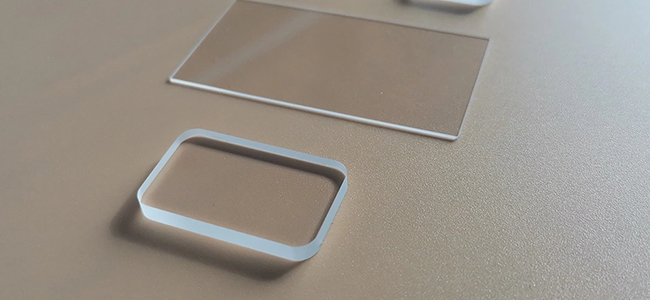
Due to the hardness of sapphire, grinding and polishing it can be rather difficult. However, in high-end applications where performance takes precedence over cost, its overall advantages make it the ‘only choice’ or the ‘optimal solution’.
I. The Three Major Optical ‘Superpowers’ of Sapphire
The ‘Transparent Guardian’ in Extreme Environments
Sapphire can withstand temperatures of up to 2,000°C without losing its transparency, and its thermal stability far exceeds that of ordinary optical glass. NASA uses it as a material for space shuttle windows, where it can withstand plasma erosion at temperatures of 1,650°C during atmospheric re-entry. The laser rangefinder on China’s Chang’e-5 mission utilises sapphire lenses; despite temperature fluctuations of 300°C between day and night on the Moon, the change in its refractive index does not exceed 0.001%, ensuring millimetre-level ranging accuracy.
The ‘energy conduit’ of the laser
High-purity sapphire (impurity content < 10 ppm) grown by the zone-melting method possesses a hexagonal crystal structure that provides perfect lattice matching for Nd:YAG lasers. In the industrial sector, German multi-kilowatt fibre laser cutting machines utilise sapphire output mirrors, enabling continuous operation for 8,000 hours without the occurrence of thermal lensing.
The ‘durability barrier’ in consumer electronics
When it comes to protecting smartphone screens, ordinary glass is prone to scratches, whereas sapphire glass, with a Mohs hardness rating of 9, is highly resistant to everyday wear and tear caused by items such as keys and grit.
II. Why is sapphire so difficult to replace?
Compared to quartz glass (which experiences a decline in light transmittance three times faster than sapphire) and polycarbonate resin (with a Vickers hardness of only 200 HV), sapphire presents a technical barrier due to its comprehensive properties: light transmittance exceeding 85% in the 0.3–4 μm wavelength range, resistance to 48% hydrofluoric acid corrosion, and a compressive strength of up to 2 GPa. Following the adoption of sapphire windows in the electro-optical targeting system (EOTS) of the US F-35 fighter jet, the maintenance interval was extended from 500 hours to 8,000 hours. In summary, sapphire is harder than glass and more stable than metal, which is the primary reason why it remains difficult to replace.
|
Materials |
Limitations |
|
Ordinary glass |
Low hardness, poor heat resistance and low chemical stability; suitable only for mild environments |
|
Gorilla Glass |
It is slightly more impact-resistant, but its hardness (~7) is far lower than that of sapphire; it is prone to scratching and is not heat-resistant. |
|
Aluminum Oxynitride(AlON) |
Although it is a polycrystalline transparent ceramic, it is difficult to produce in large sizes, is costly, and does not offer the same optical uniformity as single-crystal sapphire. |
|
Spinel ceramics |
The purity of the raw material is difficult to control; particle size affects optical properties; and its flexural strength is lower than that of sapphire. |
III.The advantages of our company’s sapphire windows
The core strength of our sapphire windows lies in our meticulous control over the intrinsic properties of the material. Unlike traditional optical materials such as ordinary glass and quartz, we utilise high-purity α-alumina (Al₂O₃) to produce synthetic monocrystalline sapphire with a purity of up to 99.997%. This eliminates the impact of impurities on optical performance at the source, ensuring consistent and stable product quality. This synthetic single-crystal structure endows the product with exceptional physical properties, including a Mohs hardness of 9 – second only to diamond. It effectively resists scratches from everyday abrasives such as grit and metal, maintaining surface integrity and optical clarity over the long term even in harsh industrial environments. This completely resolves the common issues of traditional optical windows being prone to scratches and wear, significantly extending equipment maintenance intervals and service life, whilst reducing customers’ operational and maintenance costs.