Performance Specifications for Narrow Bandpass Filters Under Standardized Calibration
2026-5-26
I. Product Specifications for Narrow Bandpass Filters
Narrow Bandpass Filters are designed to precisely transmit light within a specified, extremely narrow wavelength band while effectively blocking all other wavelengths. Key performance parameters include: center wavelength, half-width bandwidth, peak transmittance, and out-of-band rejection.
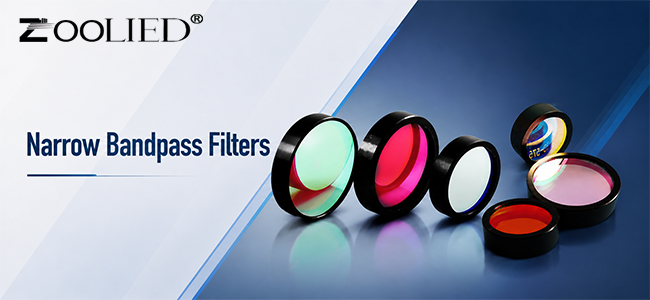
Zoolied’s Narrow Bandpass Filters are manufactured using the principle of multi-layer dielectric thin-film interference, covering the full spectrum from ultraviolet to visible, near-infrared, and mid-to-far infrared. Standard products have a passband width of 5–50 nm, while high-end precision custom models can achieve a passband width of 0.5–3 nm. These products have an extremely low tolerance for optical errors. Factory-standard products inherently contain process-related errors, and even minor parameter deviations can directly cause detection failures or data inaccuracies in end-user equipment. Therefore, precision calibration is a critical post-production process to ensure products meet specifications and are shipped in compliance with standards.
Full-band product classification and core application wavelengths:
1.UV narrow bandpass filters (<400nm): Representative wavelengths include 266 nm (fourth-harmonic YAG laser) and 365 nm (i-line lithography). These are commonly used in precision lithography, UV laser detection, and UV spectral analysis applications.
2.Visible narrow bandpass filters (400-700nm): Representative wavelengths include 532 nm (green laser) and 632.8 nm (He-Ne laser), suitable for visible laser positioning and visual inspection equipment.
3.NIR narrow bandpass filters (700-2500nm): Representative wavelengths include 1064 nm (YAG laser) and 1550 nm (fiber optics), widely used in laser processing, fiber optics, and infrared sensing and detection.
4.Mid- and far-infrared narrow bandpass filters (>3μm): Representative wavelengths include 10.6μm (CO₂ laser), suitable for infrared thermal imaging, laser cutting, and mid-to-far infrared precision detection equipment.
II. Specification Deviations in Uncalibrated Finished Filters and the Impact of Equipment
Due to fluctuations in the temperature of the coating chamber, vacuum level, and film deposition rate, uncalibrated mass-produced virgin optical filters fail to meet the compatibility standards for end-user devices in several specifications. Common error issues are present across the entire product range. The specific errors and their impacts are as follows:
Excessive center wavelength shift: The wavelength shift of uncalibrated products typically ranges from ±3 to 8 nm. Measurement data from end-user equipment shows that when the full-band wavelength deviation exceeds ±2 nm, the effective signal transmittance drops by 20%–40%, leading to laser detection errors, lithography imaging deviations, and distorted spectral detection data. This has a particularly significant impact on precision equipment operating in the ultraviolet and mid-to-far infrared spectrums.
Transmittance specifications do not meet standards: The peak transmittance of the uncalibrated product in the passband is only 75%–85%, which is below the basic compatibility standard of ≥88% for full-band industrial equipment. This results in severely insufficient sensitivity in applications such as low-light UV detection, precision mid- and far-infrared sensing, and long-distance laser communication, and fails to meet the requirements for use in precision equipment.
Insufficient cut-off depth specifications: Conventional mass-produced blank products only meet OD3–OD4 cut-off specifications, resulting in poor stray light suppression. In environments with strong outdoor light, complex workshop lighting conditions, or light interference from industrial dust, this can easily lead to incorrect exposure in lithography equipment, false triggers in laser detection systems, and drift in infrared detection data.
Poor batch-to-batch consistency: Inconsistent coating stress and lens flatness result in significant variation in product parameters across the full wavelength range within the same batch, making them unsuitable for automated, standardized assembly and mass production in lithography equipment, laser communication equipment, and infrared imaging equipment.
III. Standardized Specifications and Parameters of the Product Following Precision Calibration
Specifications for central wavelength accuracy: For general-purpose industrial-grade full-band products, the tolerance is ≤±2 nm; for high-end scientific research, lithography, and laser precision inspection custom products, the tolerance is strictly controlled at ≤±1 nm, fully matching the specifications of mainstream light source wavelengths such as 266 nm, 365 nm, 532 nm, 632.8 nm, 1064 nm, 1550 nm, and 10.6 μm.
Peak transmittance specifications: Peak transmittance ≥90% after calibration in the UV and visible light bands; specialized filters for the 1064 nm and 1550 nm near-infrared and 10.6 μm mid-to-far-infrared bands maintain a stable transmittance of ≥88% after calibration, meeting the qualification standards for laser equipment, fiber optic communications, and lithography equipment.
Out-of-band attenuation specifications: Our high-end, detection-grade full-band products achieve OD6 deep attenuation, effectively blocking stray light across the entire 200–1200 nm wavelength range, with an out-of-band stray light transmittance of ≤0.001%. This significantly improves the device’s signal-to-noise ratio and makes it suitable for a wide range of complex environments involving strong light and stray light.
Appearance and Stability Specifications: After calibration, the flatness error of the lens is ≤λ/10; the consistency error among products from the same batch is ≤1%; the environmental compatibility specifications cover a wide temperature range of -40°C to +85°C, meeting the stringent industrial standards for applications such as lithography, laser communication, and infrared detection.
Comparison Table of Product Specifications Before and After Narrow Bandpass Filters Calibration
Narrow Bandpass Filters are designed to precisely transmit light within a specified, extremely narrow wavelength band while effectively blocking all other wavelengths. Key performance parameters include: center wavelength, half-width bandwidth, peak transmittance, and out-of-band rejection.
Zoolied’s Narrow Bandpass Filters are manufactured using the principle of multi-layer dielectric thin-film interference, covering the full spectrum from ultraviolet to visible, near-infrared, and mid-to-far infrared. Standard products have a passband width of 5–50 nm, while high-end precision custom models can achieve a passband width of 0.5–3 nm. These products have an extremely low tolerance for optical errors. Factory-standard products inherently contain process-related errors, and even minor parameter deviations can directly cause detection failures or data inaccuracies in end-user equipment. Therefore, precision calibration is a critical post-production process to ensure products meet specifications and are shipped in compliance with standards.
Full-band product classification and core application wavelengths:
1.UV narrow bandpass filters (<400nm): Representative wavelengths include 266 nm (fourth-harmonic YAG laser) and 365 nm (i-line lithography). These are commonly used in precision lithography, UV laser detection, and UV spectral analysis applications.
2.Visible narrow bandpass filters (400-700nm): Representative wavelengths include 532 nm (green laser) and 632.8 nm (He-Ne laser), suitable for visible laser positioning and visual inspection equipment.
3.NIR narrow bandpass filters (700-2500nm): Representative wavelengths include 1064 nm (YAG laser) and 1550 nm (fiber optics), widely used in laser processing, fiber optics, and infrared sensing and detection.
4.Mid- and far-infrared narrow bandpass filters (>3μm): Representative wavelengths include 10.6μm (CO₂ laser), suitable for infrared thermal imaging, laser cutting, and mid-to-far infrared precision detection equipment.
II. Specification Deviations in Uncalibrated Finished Filters and the Impact of Equipment
Due to fluctuations in the temperature of the coating chamber, vacuum level, and film deposition rate, uncalibrated mass-produced virgin optical filters fail to meet the compatibility standards for end-user devices in several specifications. Common error issues are present across the entire product range. The specific errors and their impacts are as follows:
Excessive center wavelength shift: The wavelength shift of uncalibrated products typically ranges from ±3 to 8 nm. Measurement data from end-user equipment shows that when the full-band wavelength deviation exceeds ±2 nm, the effective signal transmittance drops by 20%–40%, leading to laser detection errors, lithography imaging deviations, and distorted spectral detection data. This has a particularly significant impact on precision equipment operating in the ultraviolet and mid-to-far infrared spectrums.
Transmittance specifications do not meet standards: The peak transmittance of the uncalibrated product in the passband is only 75%–85%, which is below the basic compatibility standard of ≥88% for full-band industrial equipment. This results in severely insufficient sensitivity in applications such as low-light UV detection, precision mid- and far-infrared sensing, and long-distance laser communication, and fails to meet the requirements for use in precision equipment.
Insufficient cut-off depth specifications: Conventional mass-produced blank products only meet OD3–OD4 cut-off specifications, resulting in poor stray light suppression. In environments with strong outdoor light, complex workshop lighting conditions, or light interference from industrial dust, this can easily lead to incorrect exposure in lithography equipment, false triggers in laser detection systems, and drift in infrared detection data.
Poor batch-to-batch consistency: Inconsistent coating stress and lens flatness result in significant variation in product parameters across the full wavelength range within the same batch, making them unsuitable for automated, standardized assembly and mass production in lithography equipment, laser communication equipment, and infrared imaging equipment.
III. Standardized Specifications and Parameters of the Product Following Precision Calibration
Specifications for central wavelength accuracy: For general-purpose industrial-grade full-band products, the tolerance is ≤±2 nm; for high-end scientific research, lithography, and laser precision inspection custom products, the tolerance is strictly controlled at ≤±1 nm, fully matching the specifications of mainstream light source wavelengths such as 266 nm, 365 nm, 532 nm, 632.8 nm, 1064 nm, 1550 nm, and 10.6 μm.
Peak transmittance specifications: Peak transmittance ≥90% after calibration in the UV and visible light bands; specialized filters for the 1064 nm and 1550 nm near-infrared and 10.6 μm mid-to-far-infrared bands maintain a stable transmittance of ≥88% after calibration, meeting the qualification standards for laser equipment, fiber optic communications, and lithography equipment.
Out-of-band attenuation specifications: Our high-end, detection-grade full-band products achieve OD6 deep attenuation, effectively blocking stray light across the entire 200–1200 nm wavelength range, with an out-of-band stray light transmittance of ≤0.001%. This significantly improves the device’s signal-to-noise ratio and makes it suitable for a wide range of complex environments involving strong light and stray light.
Appearance and Stability Specifications: After calibration, the flatness error of the lens is ≤λ/10; the consistency error among products from the same batch is ≤1%; the environmental compatibility specifications cover a wide temperature range of -40°C to +85°C, meeting the stringent industrial standards for applications such as lithography, laser communication, and infrared detection.
Comparison Table of Product Specifications Before and After Narrow Bandpass Filters Calibration
|
|
Condition of the blank before machining |
Standard specifications of finished products after adjustment
|
Specification optimization effect |
|
Center wavelength shift |
±3~8nm deviation exceeds the standard and can easily lead to signal attenuation |
Industrial grade ≤ ±2nm; Precision grade ≤ ±1nm |
Precise spectral positioning completely solves the problems of detection data distortion and ranging deviation |
|
Peak transmittance |
75%~85%, failing to meet industrial compatibility standards, high optical loss |
Conventional band ≥90%; Infrared band ≥88% |
Improve sensor receiving sensitivity to adapt to low-light and long-distance detection conditions |
|
Out-of-band cutoff depth |
OD3~OD4, stray light suppression specifications are relatively low, and anti-interference is weak |
High-end OD6, out-of-band transmittance ≤0.001% |
Significantly improves the signal-to-noise ratio of the equipment, eliminating strong light interference and equipment mis-triggered events |
|
Flatness & Batch Consistency |
Uneven stress, large flatness deviation, and discrete batch parameters |
Flatness ≤ λ/10, batch parameter error ≤ 1% |
Standardized product specifications meet the requirements of automated mass assembly |
|
Environmental Adaptation Specifications |
Poor temperature stability; prone to spectral distortion in high and low temperature environments |
Suitable for wide temperature range of -40℃ to +85℃ |
Long-term continuous operation without specification drift reduces equipment failure rate |