How to Select the Right Cylindrical Lens: A Comprehensive Guide from Core Parameters to Application Scenarios
2026-2-12
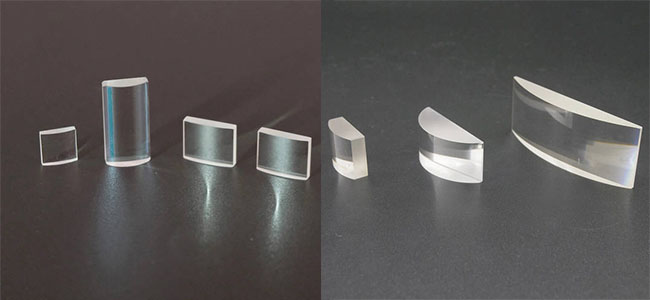
In optical systems such as laser beam shaping, fiber coupling, and precision inspection, cylindrical lenses play a crucial role in one-dimensional magnification and astigmatism correction. Unlike the symmetric focusing of spherical lenses, cylindrical lenses possess optical focus only in the direction perpendicular to their cylindrical axis. This characteristic introduces a unique dimension to their selection logic. This paper analyzes the decision-making process for selecting cylindrical lenses across four key dimensions: material, shape, precision, and coating.
I. Wavelength Determines Material Selection: Primary Constraints of Transmittance and Thermal Stability
The top priority in material selection is matching the operational wavelength range. Fused silica exhibits exceptionally high transmittance across the ultraviolet to near-infrared spectrum (185-2100 nm) and features a lower thermal expansion coefficient than standard glass, making it an ideal choice for ArF excimer lasers or semiconductor inspection. Optical glass (K9/BK7) excels in the visible-near-infrared range (350–2000 nm) at a lower cost, making it suitable for conventional industrial lasers and illumination systems. For mid-infrared (2–16 μm) applications, zinc selenide (ZnSe) or single-crystal silicon materials must be selected. For reflective optical paths, cylindrical mirrors should be chosen with gold coating (infrared) or protective aluminum coating (visible light) configured according to wavelength.
II. Shape Determines Function: The Logic of Focusing/Diverging and Beam Shaping
The shape of a cylindrical mirror dictates its interaction with light beams. Plano-convex cylindrical mirrors can focus collimated beams into line spots or diverge point sources into fan patterns; plano-concave cylindrical mirrors are used to diverge beams or broaden linewidths. Special attention must be paid to directional rules: To minimize spherical aberration, collimated light should be incident on the curved surface to focus into a line; line sources require incidence on the flat surface to achieve collimation. In laser diode beam shaping applications, a pair of orthogonally arranged cylindrical lenses is commonly used. Their focal length ratio must strictly match the ratio of the fast and slow axis divergence angles, while the spacing is calculated based on the difference in back focal lengths.
III. Tolerance-Defined Precision: Quantified Selection of Surface Quality and Eccentricity
Cylindrical mirrors present greater manufacturing challenges than spherical mirrors, with their tolerance grades directly impacting system wavefront quality. For general industrial applications (e.g., lighting, barcode scanning), surface roughness 60-40, form accuracy λ/2, and eccentricity below 3-5 arcminutes suffice. Precision imaging or high-power lasers demand upgraded specifications: roughness 20-10, form λ/10, and eccentricity better than 30 arcseconds. At this level, substrate materials are often upgraded to fused quartz to minimize stress birefringence. Regarding dimensional tolerances, high-precision customization can achieve ±0.01mm, while standard off-the-shelf components typically offer +0.0/-0.1mm.
IV. Coating Efficiency Determination: Marginal Gains in Anti-Reflection and Damage Resistance
Uncoated cylindrical mirrors suffer approximately 4% loss per surface due to Fresnel reflection. Broadband anti-reflective coatings (e.g., 400-700nm AR) reduce residual reflection below 1%; laser-line coatings (e.g., 1064nm high damage threshold films) withstand 4J/cm²@10ns pulses. High-power applications additionally require water-cooled mounts to suppress thermal lensing effects.
In summary, cylindrical mirror selection is not an isolated parameter comparison but a chained decision involving wavelength, shape, precision, and coating. First, clearly define the system's wavelength band, power, and aberration tolerance. Then, work backward to derive the required specifications for each dimension. This approach enables the optimal balance between off-the-shelf catalog options and custom solutions.
The top priority in material selection is matching the operational wavelength range. Fused silica exhibits exceptionally high transmittance across the ultraviolet to near-infrared spectrum (185-2100 nm) and features a lower thermal expansion coefficient than standard glass, making it an ideal choice for ArF excimer lasers or semiconductor inspection. Optical glass (K9/BK7) excels in the visible-near-infrared range (350–2000 nm) at a lower cost, making it suitable for conventional industrial lasers and illumination systems. For mid-infrared (2–16 μm) applications, zinc selenide (ZnSe) or single-crystal silicon materials must be selected. For reflective optical paths, cylindrical mirrors should be chosen with gold coating (infrared) or protective aluminum coating (visible light) configured according to wavelength.
II. Shape Determines Function: The Logic of Focusing/Diverging and Beam Shaping
The shape of a cylindrical mirror dictates its interaction with light beams. Plano-convex cylindrical mirrors can focus collimated beams into line spots or diverge point sources into fan patterns; plano-concave cylindrical mirrors are used to diverge beams or broaden linewidths. Special attention must be paid to directional rules: To minimize spherical aberration, collimated light should be incident on the curved surface to focus into a line; line sources require incidence on the flat surface to achieve collimation. In laser diode beam shaping applications, a pair of orthogonally arranged cylindrical lenses is commonly used. Their focal length ratio must strictly match the ratio of the fast and slow axis divergence angles, while the spacing is calculated based on the difference in back focal lengths.
III. Tolerance-Defined Precision: Quantified Selection of Surface Quality and Eccentricity
Cylindrical mirrors present greater manufacturing challenges than spherical mirrors, with their tolerance grades directly impacting system wavefront quality. For general industrial applications (e.g., lighting, barcode scanning), surface roughness 60-40, form accuracy λ/2, and eccentricity below 3-5 arcminutes suffice. Precision imaging or high-power lasers demand upgraded specifications: roughness 20-10, form λ/10, and eccentricity better than 30 arcseconds. At this level, substrate materials are often upgraded to fused quartz to minimize stress birefringence. Regarding dimensional tolerances, high-precision customization can achieve ±0.01mm, while standard off-the-shelf components typically offer +0.0/-0.1mm.
IV. Coating Efficiency Determination: Marginal Gains in Anti-Reflection and Damage Resistance
Uncoated cylindrical mirrors suffer approximately 4% loss per surface due to Fresnel reflection. Broadband anti-reflective coatings (e.g., 400-700nm AR) reduce residual reflection below 1%; laser-line coatings (e.g., 1064nm high damage threshold films) withstand 4J/cm²@10ns pulses. High-power applications additionally require water-cooled mounts to suppress thermal lensing effects.
In summary, cylindrical mirror selection is not an isolated parameter comparison but a chained decision involving wavelength, shape, precision, and coating. First, clearly define the system's wavelength band, power, and aberration tolerance. Then, work backward to derive the required specifications for each dimension. This approach enables the optimal balance between off-the-shelf catalog options and custom solutions.