Analysis of Infrared Optical Materials - Silicon
2026-1-29
In infrared detection and imaging technology, the ability to efficiently transmit infrared radiation within specific wavelength bands constitutes the core criterion for selecting optical materials. Among numerous infrared optical materials, infrared-grade single-crystal silicon, owing to its unique physicochemical properties, stands as one of the most critical and widely applied materials for mid-wave infrared and certain long-wave infrared atmospheric windows. It may well be termed the “cornea” of modern infrared systems.
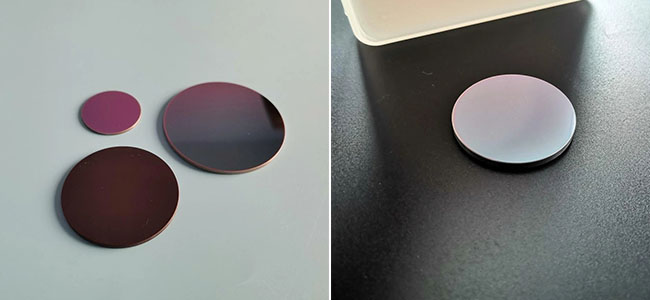
Its primary advantage lies in its exceptional optical transmission properties. Single-crystal silicon, produced through specialised purification and growth processes, exhibits extremely high transmittance in the mid-infrared spectrum (particularly between 3 and 5 micrometres), typically exceeding 50%. This characteristic enables it to efficiently transmit infrared signals emitted or reflected by target objects, thereby facilitating the capture of clear thermal images by infrared sensors.
Its outstanding comprehensive physical properties form the cornerstone of its extensive applications. Silicon's high hardness and mechanical strength render optical components wear-resistant, easy to machine and polish, achieving exceptional surface flatness and finish. Its thermal conductivity significantly exceeds that of many other infrared materials (such as germanium), facilitating heat dissipation, reducing mirror distortion caused by thermal gradients, and enhancing system stability under temperature variations. Concurrently, silicon's low density facilitates system weight reduction, proving particularly crucial in weight-sensitive sectors such as aerospace.
Moreover, silicon offers relatively controlled material costs and outstanding stability. Compared to materials with equivalent performance, such as zinc sulphide or zinc selenide, the preparation process for monocrystalline silicon is more mature, with readily available raw material sources. It exhibits chemical stability at room temperature, is insoluble in water, and its surface can be further enhanced with robust anti-reflective hard coatings to improve durability and resistance to environmental corrosion.
Naturally, the application of infrared silicon must also consider its limitations. As an intrinsically absorbing material, it is unsuitable for long-wave infrared wavelengths exceeding its absorption edge (transmittance declines sharply beyond approximately 7 micrometres). Furthermore, being a semiconductor material with a relatively high refractive index (~3.4), it necessitates precision anti-reflective coating to substantially reduce surface reflection losses.
Currently, infrared silicon finds extensive application in thermal imaging systems, infrared guidance windows, laser transmission systems, meteorological monitoring, and high-end industrial temperature measurement. As infrared technology continues to evolve towards lower cost, higher performance, and lighter weight, infrared silicon—with its balanced combination of performance and cost—remains an indispensable foundational material. It continues to play a pivotal role in dual-use military and civilian technologies, providing crucial insight into the ‘thermal world’.
Zoolied Inc. is a professional SOI manufacturer, offers a variety of optical Glass Wafers, such as Dummy Silicon Wafers, Jgs1 Wafers, and K9 Wafers, and Bk7 Wafers. Zoolied provides multiple anti-reflection coating options and also provides uncoated optical glass wafers.
Its outstanding comprehensive physical properties form the cornerstone of its extensive applications. Silicon's high hardness and mechanical strength render optical components wear-resistant, easy to machine and polish, achieving exceptional surface flatness and finish. Its thermal conductivity significantly exceeds that of many other infrared materials (such as germanium), facilitating heat dissipation, reducing mirror distortion caused by thermal gradients, and enhancing system stability under temperature variations. Concurrently, silicon's low density facilitates system weight reduction, proving particularly crucial in weight-sensitive sectors such as aerospace.
Moreover, silicon offers relatively controlled material costs and outstanding stability. Compared to materials with equivalent performance, such as zinc sulphide or zinc selenide, the preparation process for monocrystalline silicon is more mature, with readily available raw material sources. It exhibits chemical stability at room temperature, is insoluble in water, and its surface can be further enhanced with robust anti-reflective hard coatings to improve durability and resistance to environmental corrosion.
Naturally, the application of infrared silicon must also consider its limitations. As an intrinsically absorbing material, it is unsuitable for long-wave infrared wavelengths exceeding its absorption edge (transmittance declines sharply beyond approximately 7 micrometres). Furthermore, being a semiconductor material with a relatively high refractive index (~3.4), it necessitates precision anti-reflective coating to substantially reduce surface reflection losses.
Currently, infrared silicon finds extensive application in thermal imaging systems, infrared guidance windows, laser transmission systems, meteorological monitoring, and high-end industrial temperature measurement. As infrared technology continues to evolve towards lower cost, higher performance, and lighter weight, infrared silicon—with its balanced combination of performance and cost—remains an indispensable foundational material. It continues to play a pivotal role in dual-use military and civilian technologies, providing crucial insight into the ‘thermal world’.
Zoolied Inc. is a professional SOI manufacturer, offers a variety of optical Glass Wafers, such as Dummy Silicon Wafers, Jgs1 Wafers, and K9 Wafers, and Bk7 Wafers. Zoolied provides multiple anti-reflection coating options and also provides uncoated optical glass wafers.