High-Power Lasers: Why Are Mirrors the Top Choice?
2026-4-14
In high-power laser applications—ranging from industrial laser processing to aerospace laser defense—the performance of optical components directly determines system stability and efficiency. As core optical components, mirrors and lenses exhibit stark differences in performance when adapted for high-power lasers due to their distinct operating principles. A comparison of specific performance data and Zoolied’s product applications reveals that mirrors, with their significant advantages, have become the preferred choice for high-power laser systems. This preference stems from the dual alignment of optical characteristics and engineering practices, a conclusion further validated by Zoolied’s in-depth R&D into both types of components. As a company dedicated to the R&D and production of high-precision optical components, Zoolied has established a strong presence in multiple fields, including lasers, aerospace, and medical applications. The performance data of its mirrors and lenses serve as direct evidence of the suitability of these two types of components for high-power laser applications.
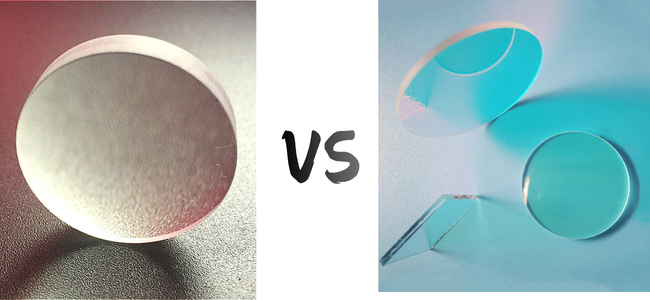 I. The Inherent Limitations of Lenses Under High-Power Lasers
Lenses rely on the refraction of light to achieve focusing and collimation; however, this “transmissive” operating mode has fatal flaws in high-energy laser environments. Specific data clearly illustrates these limitations, and test results for Zoolied’s lens products confirm this.
First, energy absorption and the thermal lensing effect are significant: the high-end quartz lenses developed by Zoolied still have an absorption rate of 0.15% to 0.3% for high-energy lasers at a wavelength of 1064 nm, which is far higher than that of mirrors of the same specifications; When laser power reaches 1000W, the energy absorbed by the lens causes its surface temperature to rise by 32–48°C, triggering the thermal lensing effect. This results in a focal shift of 0.12–0.28 mm and a deterioration of the beam quality M² factor from 1.2 to over 2.4, severely compromising system accuracy.
Second, the laser damage threshold is low: the laser-induced damage threshold of ordinary optical glass lenses is only 85–115 J/cm² (1064 nm, 10 ns pulse), whereas the instantaneous energy density of high-power lasers often exceeds 150 J/cm², making it extremely prone to surface ablation and internal cracking. Their service life is less than 480 hours, far shorter than that of their mirror counterparts.
Furthermore, issues with chromatic and spherical aberrations are significant: test data shows that the refractive index variation of these lenses across different laser wavelengths can reach 0.002–0.0045. Even with a three-element correction system, aberrations cannot be fully eliminated, resulting in a 16%–19% increase in the beam divergence angle. As a company that provides customized optical lenses, Zoolied’s test data further demonstrates that the limitations of these lenses in high-energy laser applications are difficult to overcome.
II. Key Advantages of Mirrors for High-Power Lasers
Mirrors operate based on the principle of light reflection, redirecting and focusing light beams through highly reflective coatings on their substrate surfaces. Their performance metrics comprehensively outperform those of lenses, fundamentally overcoming the limitations of lenses. Zoolied’s mirrors provide strong support in this regard. With deep expertise in mirrors R&D, Zoolied offers a range of customized products featuring various coatings, such as aluminum and dielectric coatings, whose performance metrics comprehensively outperform those of lenses of the same specifications.
First, extremely low energy loss: Zoolied’s high-quality dielectric film mirrors achieve a reflectance of over 99.6% for 1064 nm wavelength lasers, with high-end custom models even exceeding 99.999%. The absorption rate is only 0.001% to 0.45%, which is 1/200 to 1/22 of the absorption rate of lenses of the same specifications. This eliminates the thermal lensing effect at its source, and the beam quality M² factor can be stably maintained between 1.1 and 1.28, with no significant focal shift.
Second, excellent thermal stability: Zoolied mirrors utilize high-quality substrates such as silicon carbide and fused silica, with thermal conductivity reaching 125–485 W/(m·K)—5.2 to 19 times that of ordinary optical glass. Even under prolonged exposure to a 1000W laser, the surface temperature increase does not exceed 4.8°C, surface figure distortion remains below λ/20 (λ = 632.8 nm), far surpassing the surface figure distortion of its lens products (λ/3.2 to λ/4.8).
Third, high damage threshold and long service life: Zoolied mirrors have a laser-induced damage threshold of 155–185 J/cm² (1064 nm, 10 ns pulse), and high-end custom models even exceed 325 kW/cm² (continuous laser), which is 1.52–1.95 times that of lenses of the same specifications; Under equivalent high-energy laser conditions, the service life of these mirrors can reach 5,200–9,800 hours, which is 10.8–19.6 times that of comparable lens products, significantly reducing system maintenance costs. Additionally, Zoolied mirrors are available in custom sizes ranging from 10 to 300 mm, with a surface finish of up to 60/40, further adapting to the needs of various high-energy laser applications.
III. Real-World Applications: The Irreplaceability of Mirrors
In the field of high-power lasers, the advantages of mirrors have been validated by concrete application data, and Zoolied’s mirror products have been successfully implemented in various scenarios, demonstrating their irreplaceable value. Zoolied mirrors are widely used in high-power applications such as spectroscopy, laser resonators, and satellite communications, and their practical application data further confirms the superiority of these mirrors. In industrial high-power laser cutting, systems using Zoolied mirrors can maintain processing accuracy within ±0.009 mm, whereas systems using lenses of the same specifications can have errors as high as ±0.048 mm or more; In laser fusion experiments, Zoolied’s custom-made mirrors can control laser focal accuracy to the 0.001 mm level, helping to increase the success rate of fusion reactions by over 31%, whereas their lens products cannot meet the precise focusing requirements due to thermal deformation. In aerospace laser defense applications, Zoolied mirrors can withstand extreme temperature fluctuations ranging from -40°C to 85°C and maintain stable reflection even under megawatt-level laser irradiation, making them suitable for the harsh conditions of space. In contrast, Zoolied’s lens products experience significant performance degradation when temperature fluctuations exceed 20°C, rendering them unsuitable for such scenarios. Furthermore, Zoolied mirrors can be customized with coatings and dimensions to meet specific customer requirements, making them suitable for a wider range of high-energy laser applications and further expanding the scope of mirror usage.
In summary, based on a comparison of key metrics such as energy absorption, damage threshold, and thermal stability, as well as Zoolied’s product development and practical applications, it is evident that mirrors outperform lenses in all aspects in high-power laser applications, effectively addressing the inherent limitations of lenses. As a specialist in the field of high-precision optical components, Zoolied’s mirror products have become indispensable core optical elements in high-power laser systems due to their superior performance. They further drive the advancement of high-power laser technology toward higher power and greater precision, providing reliable optical solutions for high-power laser applications across various industries.
Summary Comparison Table
Lenses rely on the refraction of light to achieve focusing and collimation; however, this “transmissive” operating mode has fatal flaws in high-energy laser environments. Specific data clearly illustrates these limitations, and test results for Zoolied’s lens products confirm this.
First, energy absorption and the thermal lensing effect are significant: the high-end quartz lenses developed by Zoolied still have an absorption rate of 0.15% to 0.3% for high-energy lasers at a wavelength of 1064 nm, which is far higher than that of mirrors of the same specifications; When laser power reaches 1000W, the energy absorbed by the lens causes its surface temperature to rise by 32–48°C, triggering the thermal lensing effect. This results in a focal shift of 0.12–0.28 mm and a deterioration of the beam quality M² factor from 1.2 to over 2.4, severely compromising system accuracy.
Second, the laser damage threshold is low: the laser-induced damage threshold of ordinary optical glass lenses is only 85–115 J/cm² (1064 nm, 10 ns pulse), whereas the instantaneous energy density of high-power lasers often exceeds 150 J/cm², making it extremely prone to surface ablation and internal cracking. Their service life is less than 480 hours, far shorter than that of their mirror counterparts.
Furthermore, issues with chromatic and spherical aberrations are significant: test data shows that the refractive index variation of these lenses across different laser wavelengths can reach 0.002–0.0045. Even with a three-element correction system, aberrations cannot be fully eliminated, resulting in a 16%–19% increase in the beam divergence angle. As a company that provides customized optical lenses, Zoolied’s test data further demonstrates that the limitations of these lenses in high-energy laser applications are difficult to overcome.
II. Key Advantages of Mirrors for High-Power Lasers
Mirrors operate based on the principle of light reflection, redirecting and focusing light beams through highly reflective coatings on their substrate surfaces. Their performance metrics comprehensively outperform those of lenses, fundamentally overcoming the limitations of lenses. Zoolied’s mirrors provide strong support in this regard. With deep expertise in mirrors R&D, Zoolied offers a range of customized products featuring various coatings, such as aluminum and dielectric coatings, whose performance metrics comprehensively outperform those of lenses of the same specifications.
First, extremely low energy loss: Zoolied’s high-quality dielectric film mirrors achieve a reflectance of over 99.6% for 1064 nm wavelength lasers, with high-end custom models even exceeding 99.999%. The absorption rate is only 0.001% to 0.45%, which is 1/200 to 1/22 of the absorption rate of lenses of the same specifications. This eliminates the thermal lensing effect at its source, and the beam quality M² factor can be stably maintained between 1.1 and 1.28, with no significant focal shift.
Second, excellent thermal stability: Zoolied mirrors utilize high-quality substrates such as silicon carbide and fused silica, with thermal conductivity reaching 125–485 W/(m·K)—5.2 to 19 times that of ordinary optical glass. Even under prolonged exposure to a 1000W laser, the surface temperature increase does not exceed 4.8°C, surface figure distortion remains below λ/20 (λ = 632.8 nm), far surpassing the surface figure distortion of its lens products (λ/3.2 to λ/4.8).
Third, high damage threshold and long service life: Zoolied mirrors have a laser-induced damage threshold of 155–185 J/cm² (1064 nm, 10 ns pulse), and high-end custom models even exceed 325 kW/cm² (continuous laser), which is 1.52–1.95 times that of lenses of the same specifications; Under equivalent high-energy laser conditions, the service life of these mirrors can reach 5,200–9,800 hours, which is 10.8–19.6 times that of comparable lens products, significantly reducing system maintenance costs. Additionally, Zoolied mirrors are available in custom sizes ranging from 10 to 300 mm, with a surface finish of up to 60/40, further adapting to the needs of various high-energy laser applications.
III. Real-World Applications: The Irreplaceability of Mirrors
In the field of high-power lasers, the advantages of mirrors have been validated by concrete application data, and Zoolied’s mirror products have been successfully implemented in various scenarios, demonstrating their irreplaceable value. Zoolied mirrors are widely used in high-power applications such as spectroscopy, laser resonators, and satellite communications, and their practical application data further confirms the superiority of these mirrors. In industrial high-power laser cutting, systems using Zoolied mirrors can maintain processing accuracy within ±0.009 mm, whereas systems using lenses of the same specifications can have errors as high as ±0.048 mm or more; In laser fusion experiments, Zoolied’s custom-made mirrors can control laser focal accuracy to the 0.001 mm level, helping to increase the success rate of fusion reactions by over 31%, whereas their lens products cannot meet the precise focusing requirements due to thermal deformation. In aerospace laser defense applications, Zoolied mirrors can withstand extreme temperature fluctuations ranging from -40°C to 85°C and maintain stable reflection even under megawatt-level laser irradiation, making them suitable for the harsh conditions of space. In contrast, Zoolied’s lens products experience significant performance degradation when temperature fluctuations exceed 20°C, rendering them unsuitable for such scenarios. Furthermore, Zoolied mirrors can be customized with coatings and dimensions to meet specific customer requirements, making them suitable for a wider range of high-energy laser applications and further expanding the scope of mirror usage.
In summary, based on a comparison of key metrics such as energy absorption, damage threshold, and thermal stability, as well as Zoolied’s product development and practical applications, it is evident that mirrors outperform lenses in all aspects in high-power laser applications, effectively addressing the inherent limitations of lenses. As a specialist in the field of high-precision optical components, Zoolied’s mirror products have become indispensable core optical elements in high-power laser systems due to their superior performance. They further drive the advancement of high-power laser technology toward higher power and greater precision, providing reliable optical solutions for high-power laser applications across various industries.
Summary Comparison Table
|
Comparison criteria |
Lens (Zoolied Product Data) |
Mirrors (Zoolied Product Data) |
Key Differences |
|
Energy absorption rate (1064 nm wavelength) |
0.15%–0.3% |
0.001%–0.45% |
The absorption rate of a mirror is only 1/200 to 1/22 that of a lens, resulting in extremely low energy loss. |
|
Laser-induced damage threshold (1064 nm, 10 ns pulse) |
85–115 J/cm² |
155–185J/cm² (High-end models exceed 325 kW/cm²) |
The damage threshold of mirror is 1.52 to 1.95 times that of lenses, and they offer greater resistance to high-energy lasers. |
|
Thermal stability (under 1000 W laser irradiation) |
Surface temperature increase: 32–48°C; surface deformation: λ/3.2–λ/4.8 |
Surface temperature rise ≤ 4.8°C, surface distortion < λ/20 (λ = 632.8 nm) |
The mirror offers superior thermal stability and exhibits no noticeable thermal lensing effect. |
|
Service life (under equivalent high-energy conditions) |
Less than 480 hours |
5,200–9,800 hours |
Mirrors have a service life 10.8 to 19.6 times longer than lenses and incur lower maintenance costs. |
|
Beam quality (M² factor) |
Worsened from 1.2 to 2.4 or higher |
Remains stable between 1.1 and 1.28 |
The beam quality of the mirror is more stable, with no noticeable shift in the focal point. |
| Adaptability to extreme environments |
Performance degradation occurs when temperature fluctuations exceed 20°C |
Withstands extreme temperature ranges from -40°C to 85°C, making it suitable for applications such as space exploration |
Mirrors offer greater versatility and meet the diverse requirements of high-power lasers across various applications |