High-power laser window, why does fused silica completely outperform BK7?
2026-5-12
In high-power industrial laser equipment such as laser cutting machines and laser welding machines, the laser protection window is the core barrier protecting the optical system. Many customers wonder: why is fused silica chosen for high-power applications, while BK7 glass is only suitable for low-power conditions, even though both are commonly used optical materials? Zoolied will provide an in-depth analysis of the key logic behind this, examining the material's nature, core performance, and practical applications.
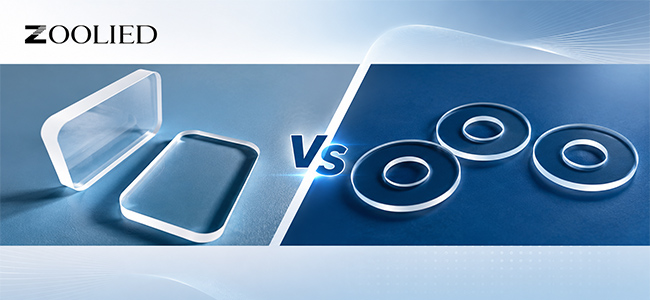
I. Inherent differences in materials:
Fused silica: Made from ultra-high purity silica (over 99.99%) through high-temperature melting and vapor deposition, it is virtually free of defects such as hydroxyl groups and metallic impurities, exhibiting a pure silica amorphous structure. This extreme purity reduces laser energy absorption at the source, forming the basis for high-power laser resistance.
BK7 glass: Belongs to borosilicate crown glass, with additional boron and potassium added to silicon dioxide to optimize processability and cost, resulting in a much higher impurity content than fused silica. This "compromise" in composition makes it inherently susceptible to the continuous impact of high-power lasers.
II. Performance Differences:
The core requirements for windows in high-power lasers are: low light absorption, high thermal stability, high damage resistance, and excellent optical uniformity. Fused silica is superior to BK7 in all four dimensions.
1. Extremely low light absorption: Reduces heat buildup and prevents thermal runaway.
Fused silica: The absorption coefficient in the 1064nm band is only on the order of 10⁻⁵/cm (<10ppm/cm), so it absorbs almost no laser energy and the heat accumulation is negligible.
BK7 glass: Its absorption coefficient in the same wavelength band is about 0.0013/cm, which is more than 100 times that of fused silica. The high absorption causes heat to accumulate rapidly, and even short-term high-power irradiation can cause thermal deformation, blackening, or even cracking.
2. Ultra-low coefficient of thermal expansion: Eliminates thermal lensing effect, ensuring cutting precision.
Fused silica has a low coefficient of thermal expansion of 0.55×10⁻⁶/°C. Its dimensions remain almost unchanged after heating, which can stably maintain the surface accuracy and completely suppress the thermal lensing effect.
BK7 glass has a coefficient of thermal expansion of approximately 7.1 × 10⁻⁶/°C, which is 13 times that of fused silica. Upon heating, it expands and deforms rapidly, causing laser focus drift, edge burning/burring during cutting, and a significant decrease in precision.
3. Ultra-high laser damage threshold: Withstands high-energy impacts and has a longer service life.
Fused silica: Under 1064nm, 10ns pulsed laser, the damage threshold can reach 15J/cm²; under continuous laser conditions, it can be stably adapted to 10,000-watt equipment, and there are no cracks or coating peeling during long-term use.
BK7 glass: Under the same conditions, the damage threshold is only about 5J/cm². Microcracks will appear if the damage exceeds 8J/cm². It is only suitable for low-power lasers of ≤500W (such as small marking machines). Under high power, it is very easy to be instantly penetrated and shattered.
4. Wide bandwidth and high transmittance + high uniformity: adaptable to various scenarios, ensuring beam quality.
Fused silica: Transmits wavelengths from 180–2500 nm (deep ultraviolet to infrared), with a transmittance of >99.6% at 1064 nm; optical homogeneity reaches ±1×10⁻⁶; internal stress-free birefringence ensures a pure and distortion-free laser beam.
BK7 glass: Transmits wavelengths only from 350–2000 nm; strong absorption in the ultraviolet band (<350 nm); poor homogeneity and stability; prone to refractive index drift at high power, affecting beam quality.
III. Practical Application Scenarios
Fused Silica Windows: A Standard Feature for High-Power Laser Equipment. Compatible with 1000W–30000W laser cutting machines, laser welding machines, and ultrafast laser equipment.
Advantages: Fast cutting (no thermal distortion, stable energy), high precision (no focus drift, high surface accuracy), long lifespan (damage resistant, reduced replacement frequency).
Value: Avoids downtime and rework due to window damage, significantly reducing long-term operating costs.
BK7 Windows: Only suitable for low-power, low-requirement scenarios.
Compatible only with ≤500W small laser marking machines and ordinary laser rangefinders.
Disadvantages: Prone to deformation and cracking at high power, resulting in poor accuracy; frequent replacements increase costs.
Value: Its only advantage is its low price; it cannot meet the "fast, accurate, and stable" requirements of industrial-grade high-power cutting.
IV. Advantages of Zoolied's fused silica window
1. High-purity substrate: Utilizes imported/domestic top-grade fused silica, with impurity content <50ppb and hydroxyl content ≤1ppm, ensuring low absorption and high damage resistance from the source;
2. Ultra-precision machining: Surface accuracy reaches λ/2–λ/10 (@632.8nm), surface roughness ≤0.5nm, ensuring precise laser beam transmission;
3. High-performance coating: Standard 1064nm/1550nm antireflective coating, transmittance >99.8%, strong film adhesion, abrasion resistance, and resistance to laser damage;
4. Full customization: Supports various shapes such as round, rectangular, and ring-shaped, with diameter/thickness customized to meet specific needs, adaptable to various high-power laser equipment.
Comparison of core parameters between fused silica and BK7
I. Inherent differences in materials:
Fused silica: Made from ultra-high purity silica (over 99.99%) through high-temperature melting and vapor deposition, it is virtually free of defects such as hydroxyl groups and metallic impurities, exhibiting a pure silica amorphous structure. This extreme purity reduces laser energy absorption at the source, forming the basis for high-power laser resistance.
BK7 glass: Belongs to borosilicate crown glass, with additional boron and potassium added to silicon dioxide to optimize processability and cost, resulting in a much higher impurity content than fused silica. This "compromise" in composition makes it inherently susceptible to the continuous impact of high-power lasers.
II. Performance Differences:
The core requirements for windows in high-power lasers are: low light absorption, high thermal stability, high damage resistance, and excellent optical uniformity. Fused silica is superior to BK7 in all four dimensions.
1. Extremely low light absorption: Reduces heat buildup and prevents thermal runaway.
Fused silica: The absorption coefficient in the 1064nm band is only on the order of 10⁻⁵/cm (<10ppm/cm), so it absorbs almost no laser energy and the heat accumulation is negligible.
BK7 glass: Its absorption coefficient in the same wavelength band is about 0.0013/cm, which is more than 100 times that of fused silica. The high absorption causes heat to accumulate rapidly, and even short-term high-power irradiation can cause thermal deformation, blackening, or even cracking.
2. Ultra-low coefficient of thermal expansion: Eliminates thermal lensing effect, ensuring cutting precision.
Fused silica has a low coefficient of thermal expansion of 0.55×10⁻⁶/°C. Its dimensions remain almost unchanged after heating, which can stably maintain the surface accuracy and completely suppress the thermal lensing effect.
BK7 glass has a coefficient of thermal expansion of approximately 7.1 × 10⁻⁶/°C, which is 13 times that of fused silica. Upon heating, it expands and deforms rapidly, causing laser focus drift, edge burning/burring during cutting, and a significant decrease in precision.
3. Ultra-high laser damage threshold: Withstands high-energy impacts and has a longer service life.
Fused silica: Under 1064nm, 10ns pulsed laser, the damage threshold can reach 15J/cm²; under continuous laser conditions, it can be stably adapted to 10,000-watt equipment, and there are no cracks or coating peeling during long-term use.
BK7 glass: Under the same conditions, the damage threshold is only about 5J/cm². Microcracks will appear if the damage exceeds 8J/cm². It is only suitable for low-power lasers of ≤500W (such as small marking machines). Under high power, it is very easy to be instantly penetrated and shattered.
4. Wide bandwidth and high transmittance + high uniformity: adaptable to various scenarios, ensuring beam quality.
Fused silica: Transmits wavelengths from 180–2500 nm (deep ultraviolet to infrared), with a transmittance of >99.6% at 1064 nm; optical homogeneity reaches ±1×10⁻⁶; internal stress-free birefringence ensures a pure and distortion-free laser beam.
BK7 glass: Transmits wavelengths only from 350–2000 nm; strong absorption in the ultraviolet band (<350 nm); poor homogeneity and stability; prone to refractive index drift at high power, affecting beam quality.
Fused Silica Windows: A Standard Feature for High-Power Laser Equipment. Compatible with 1000W–30000W laser cutting machines, laser welding machines, and ultrafast laser equipment.
Advantages: Fast cutting (no thermal distortion, stable energy), high precision (no focus drift, high surface accuracy), long lifespan (damage resistant, reduced replacement frequency).
Value: Avoids downtime and rework due to window damage, significantly reducing long-term operating costs.
BK7 Windows: Only suitable for low-power, low-requirement scenarios.
Compatible only with ≤500W small laser marking machines and ordinary laser rangefinders.
Disadvantages: Prone to deformation and cracking at high power, resulting in poor accuracy; frequent replacements increase costs.
Value: Its only advantage is its low price; it cannot meet the "fast, accurate, and stable" requirements of industrial-grade high-power cutting.
IV. Advantages of Zoolied's fused silica window
1. High-purity substrate: Utilizes imported/domestic top-grade fused silica, with impurity content <50ppb and hydroxyl content ≤1ppm, ensuring low absorption and high damage resistance from the source;
2. Ultra-precision machining: Surface accuracy reaches λ/2–λ/10 (@632.8nm), surface roughness ≤0.5nm, ensuring precise laser beam transmission;
3. High-performance coating: Standard 1064nm/1550nm antireflective coating, transmittance >99.8%, strong film adhesion, abrasion resistance, and resistance to laser damage;
4. Full customization: Supports various shapes such as round, rectangular, and ring-shaped, with diameter/thickness customized to meet specific needs, adaptable to various high-power laser equipment.
Comparison of core parameters between fused silica and BK7
|
|
Fused Silica |
BK7 |
|
Material purity |
Ultra-high purity SiO₂ with extremely low impurities |
The addition of boron and potassium results in a higher impurity level |
|
Coefficient of thermal expansion |
Extremely low temperature, minimal thermal distortion |
Large values indicate a tendency to deform when heated |
|
Laser damage threshold |
>15J/cm² |
Approximately 5 J/cm² |
|
Laser power tolerance |
It can stably withstand 10,000W+ kilowatt levels |
Only compatible with low power consumption up to 500W
|
|
Light absorption loss |
Extremely low, almost no heat retention |
High absorption, easily accumulates heat and causes burning sensation |
|
Applicable bands |
Deep ultraviolet to near infrared, with a wider wavelength range |
Visible light to near-infrared only, ultraviolet cutoff |
|
Surface stability |
Maintain high precision at high temperatures (λ/2~λ/10) |
Severe distortion of heated surface
|
|
Applicable Scenarios |
Laser cutting, 10,000-watt welding, ultrafast laser |
Small marking machine, ordinary low-power optics
|
|
Cost positioning |
Mid-to-high-end industrial grade |
Entry-level economy |