Differences in the Optical Properties and Applications of Plano-Convex Lenses and Positive Meniscus Lenses
2026-5-6
In optical system design, plano-convex lenses and positive meniscus lenses are both core converging elements, widely used in imaging, laser focusing, and optical path calibration. Although both are positive lenses (positive focal length, converging light rays), they differ fundamentally in structural configuration, optical parameters, aberration characteristics, and applicable scenarios, directly determining the imaging quality, size control, and cost optimization of the optical system.
I. Differences in Structure and Geometric Characteristics
1. Plano-convex lens
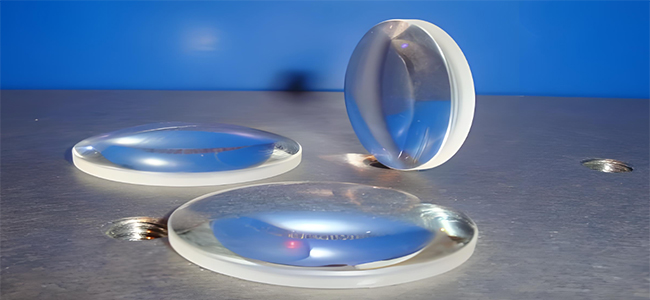
A plano-convex lens has an asymmetrical single-spherical configuration, with one side being perfectly flat (radius of curvature R → ∞) and the other side being a convex surface. The overall shape resembles a “flat plate + convex arc,” with the thickness at the center being greater than that at the edges. It is the simplest type of positive lens.
Geometric parameters: The optical power is contributed solely by the convex spherical surface, simplifying the focal length formula to f = R/(n-1) (where n is the refractive index of the lens material and R is the radius of curvature of the convex surface); the flat surface makes no contribution to refraction and serves only to stabilize the optical path. The lens exhibits high thickness uniformity and is manufactured using a mature process; diameter tolerances can reach +0/-0.02 mm, and central thickness tolerances are ±0.02 mm.
2.Positive Meniscus Lens
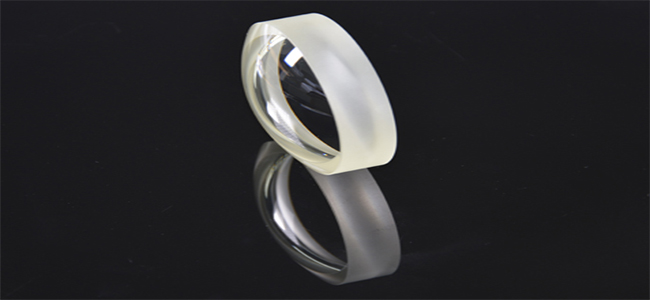
A positive meniscus lens has a double-spherical asymmetric configuration, with one side being convex and the other side being concave, and the whole is crescent-shaped. Its core feature is that the absolute value of the radius of curvature of the convex surface is smaller than that of the concave surface, the edge thickness is slightly greater than the center thickness, and the overall lens still has converging properties.
Geometric parameters: The radii of curvature of the two refractive surfaces have the same sign; the focal length is determined by the curvature difference between the convex and concave surfaces; and the optical power is the result of the superposition of refraction from the two spherical surfaces. Compared to plano-convex lenses, positive meniscus lenses have a more flexible thickness distribution and can be adapted to different focal lengths and aberration correction requirements by adjusting the concave-convex curvature ratio.
II. Differences in Optical Principles and Light Manipulation Characteristics
1. Plano-convex lens: unidirectional refraction, simple optical path.
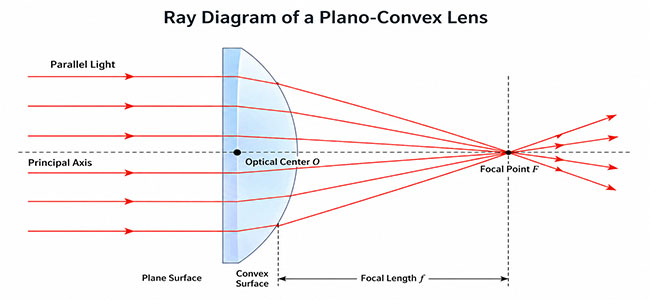
The refraction of light by a plano-convex lens follows the core logic of "stabilizing light on a planar surface and concentrating light on a convex surface":
When parallel light enters from a plane, it is almost unreflected, enters the lens perpendicularly, and undergoes strong refraction only when exiting from the convex surface, converging uniformly at the focal point. Spherical aberration is easy to control. When light enters from a convex surface, it is initially deflected by the convex surface and converges completely when exiting from the plane. At this point, spherical aberration increases slightly. Therefore, plano-convex lenses cannot be used in reverse, as their orientation directly affects imaging accuracy.
Its core optical characteristics are: single refraction path, uniform light deflection, and less stray light, making it suitable for basic convergence and collimation scenarios. However, its single-chip spherical aberration correction capability is limited, and the edge light focus deviates significantly from the paraxial focus.
2. Positive meniscus lens: Hyperboloid fine-tuning, aberration optimization
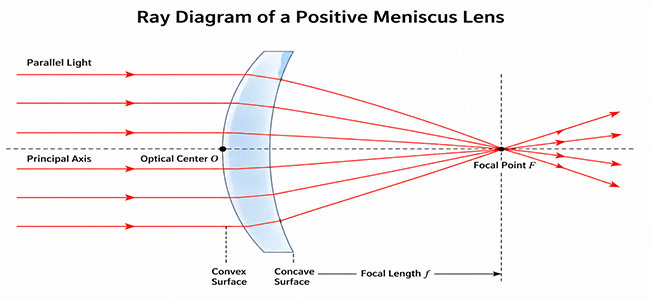
A positive meniscus lens manipulates light through a dual refraction mechanism of "convex convergence and concave correction":
The convex surface is responsible for the main converging function, initially focusing parallel light; the concave surface fine-tunes the optical path in the opposite direction, counteracting some of the spherical aberrations caused by the convex surface, achieving integrated "convergence + correction".
The curvature difference between the two spherical surfaces determines the focal length; the smaller the curvature difference, the longer the focal length; the larger the curvature difference, the shorter the focal length, allowing for flexible adaptation to short focal length and high numerical aperture scenarios.
Its core optical characteristics include: natural spherical aberration correction capability, which can reduce edge light refraction error with a single lens; the main surface can be located outside the lens, adapting to optical path folding design and significantly reducing the size of the optical system.
III. Aberration Characteristics and Differences in Image Quality
1. Plano-convex lens: fundamental aberrations, suitable for general scenarios.
Spherical aberration: A single plano-convex lens has a large spherical aberration. The convergence point of peripheral rays is close to the lens, while the convergence point of paraxial rays is far from the lens, resulting in a larger spot diameter (e.g., the spot diameter of a 100mm plano-convex lens is about 240μm).
Color difference: Different wavelengths of light refract to different degrees, resulting in slight color differences, which need to be corrected by coating or multi-lens combination.
Applicable scenarios: Scenarios where general imaging accuracy is not required, such as magnifying glasses, basic condenser lenses, and simple telescopes.
2. Positive meniscus lens: Low aberrations, suitable for high-precision scenarios.
Spherical aberration: The complementary design of concave and convex hyperboloids can significantly cancel spherical aberration. The spherical aberration of a single lens is only 1/3 to 1/2 of that of a plano-convex lens, and the spot diameter can be reduced to below 80μm, which is close to the diffraction limit.
Coma and Chromatic Aberration: The symmetrical curvature design can suppress coma, and when combined with special materials (such as low-dispersion glass), chromatic aberration can be further reduced, resulting in a significant improvement in image clarity.
Applicable scenarios: High-precision imaging scenarios, such as camera zoom lenses, microscope eyepieces, laser focusing systems, high-end telescopes, etc.
Core Parameter Comparison Table
IV. Selection Recommendations
Zoolied recommends that you follow these principles when selecting an optical system:
For scenarios with moderate imaging accuracy requirements and limited budgets, plano-convex lenses should be preferred.
For scenarios with stringent requirements on imaging resolution, spot quality, and system size, positive meniscus lenses should be the preferred choice.
In complex optical systems, the two can be used in combination to balance performance and cost, achieving optimal optical path design.
I. Differences in Structure and Geometric Characteristics
1. Plano-convex lens
A plano-convex lens has an asymmetrical single-spherical configuration, with one side being perfectly flat (radius of curvature R → ∞) and the other side being a convex surface. The overall shape resembles a “flat plate + convex arc,” with the thickness at the center being greater than that at the edges. It is the simplest type of positive lens.
Geometric parameters: The optical power is contributed solely by the convex spherical surface, simplifying the focal length formula to f = R/(n-1) (where n is the refractive index of the lens material and R is the radius of curvature of the convex surface); the flat surface makes no contribution to refraction and serves only to stabilize the optical path. The lens exhibits high thickness uniformity and is manufactured using a mature process; diameter tolerances can reach +0/-0.02 mm, and central thickness tolerances are ±0.02 mm.
2.Positive Meniscus Lens
A positive meniscus lens has a double-spherical asymmetric configuration, with one side being convex and the other side being concave, and the whole is crescent-shaped. Its core feature is that the absolute value of the radius of curvature of the convex surface is smaller than that of the concave surface, the edge thickness is slightly greater than the center thickness, and the overall lens still has converging properties.
Geometric parameters: The radii of curvature of the two refractive surfaces have the same sign; the focal length is determined by the curvature difference between the convex and concave surfaces; and the optical power is the result of the superposition of refraction from the two spherical surfaces. Compared to plano-convex lenses, positive meniscus lenses have a more flexible thickness distribution and can be adapted to different focal lengths and aberration correction requirements by adjusting the concave-convex curvature ratio.
II. Differences in Optical Principles and Light Manipulation Characteristics
1. Plano-convex lens: unidirectional refraction, simple optical path.
The refraction of light by a plano-convex lens follows the core logic of "stabilizing light on a planar surface and concentrating light on a convex surface":
When parallel light enters from a plane, it is almost unreflected, enters the lens perpendicularly, and undergoes strong refraction only when exiting from the convex surface, converging uniformly at the focal point. Spherical aberration is easy to control. When light enters from a convex surface, it is initially deflected by the convex surface and converges completely when exiting from the plane. At this point, spherical aberration increases slightly. Therefore, plano-convex lenses cannot be used in reverse, as their orientation directly affects imaging accuracy.
Its core optical characteristics are: single refraction path, uniform light deflection, and less stray light, making it suitable for basic convergence and collimation scenarios. However, its single-chip spherical aberration correction capability is limited, and the edge light focus deviates significantly from the paraxial focus.
2. Positive meniscus lens: Hyperboloid fine-tuning, aberration optimization
A positive meniscus lens manipulates light through a dual refraction mechanism of "convex convergence and concave correction":
The convex surface is responsible for the main converging function, initially focusing parallel light; the concave surface fine-tunes the optical path in the opposite direction, counteracting some of the spherical aberrations caused by the convex surface, achieving integrated "convergence + correction".
The curvature difference between the two spherical surfaces determines the focal length; the smaller the curvature difference, the longer the focal length; the larger the curvature difference, the shorter the focal length, allowing for flexible adaptation to short focal length and high numerical aperture scenarios.
Its core optical characteristics include: natural spherical aberration correction capability, which can reduce edge light refraction error with a single lens; the main surface can be located outside the lens, adapting to optical path folding design and significantly reducing the size of the optical system.
III. Aberration Characteristics and Differences in Image Quality
1. Plano-convex lens: fundamental aberrations, suitable for general scenarios.
Spherical aberration: A single plano-convex lens has a large spherical aberration. The convergence point of peripheral rays is close to the lens, while the convergence point of paraxial rays is far from the lens, resulting in a larger spot diameter (e.g., the spot diameter of a 100mm plano-convex lens is about 240μm).
Color difference: Different wavelengths of light refract to different degrees, resulting in slight color differences, which need to be corrected by coating or multi-lens combination.
Applicable scenarios: Scenarios where general imaging accuracy is not required, such as magnifying glasses, basic condenser lenses, and simple telescopes.
2. Positive meniscus lens: Low aberrations, suitable for high-precision scenarios.
Spherical aberration: The complementary design of concave and convex hyperboloids can significantly cancel spherical aberration. The spherical aberration of a single lens is only 1/3 to 1/2 of that of a plano-convex lens, and the spot diameter can be reduced to below 80μm, which is close to the diffraction limit.
Coma and Chromatic Aberration: The symmetrical curvature design can suppress coma, and when combined with special materials (such as low-dispersion glass), chromatic aberration can be further reduced, resulting in a significant improvement in image clarity.
Applicable scenarios: High-precision imaging scenarios, such as camera zoom lenses, microscope eyepieces, laser focusing systems, high-end telescopes, etc.
Core Parameter Comparison Table
|
|
Plano-Convex Lens |
Positive Meniscus Lenses |
|
Structure & Configuration |
One plane, one convex surface; single spherical refraction |
One convex, one concave surface; double spherical refraction |
|
Focal Length Characteristics |
Determined by the curvature of the convex surface, formula: f = R/(n-1) |
Determined by the difference between convex and concave curvatures; wider adjustable range |
|
Aberration Level |
Significant spherical aberration for a single lens; slight chromatic aberration |
Spherical aberration is significantly reduced; strong coma / chromatic aberration suppression |
|
Numerical Aperture (NA) |
Medium, suitable for conventional aperture beams |
High, suitable for large-aperture, short-focal-length beams |
|
System Volume |
Requires larger space; optical path cannot be folded |
Reduces system volume; suitable for compact optical path design |
|
Cost & Manufacturing |
Simple processing, low cost, good mass producibility |
Complex processing, higher cost, strict precision requirements |
|
Typical Applications
|
Magnifying glasses, laser pointers, simple telescopes |
Camera lenses, laser processing, microscope eyepieces |
IV. Selection Recommendations
Zoolied recommends that you follow these principles when selecting an optical system:
For scenarios with moderate imaging accuracy requirements and limited budgets, plano-convex lenses should be preferred.
For scenarios with stringent requirements on imaging resolution, spot quality, and system size, positive meniscus lenses should be the preferred choice.
In complex optical systems, the two can be used in combination to balance performance and cost, achieving optimal optical path design.