Why does a fused silica ring need to be "drilled"?
2026-6-23
In the semiconductor, fiber optic communications, and aerospace industries, there is a seemingly unremarkable component—the fused silica ring. It doesn't "show off" like a lens, nor does it alter optical paths like a prism. Yet without it, lithography machines could not focus precisely, fiber optic signals might suffer attenuation, and even spacecraft attitude control systems could fail.
Today, we are not going to discuss grand application stories. Instead, we will focus on one specific manufacturing step: drilling the blank.
Why "Drill a Hole"?
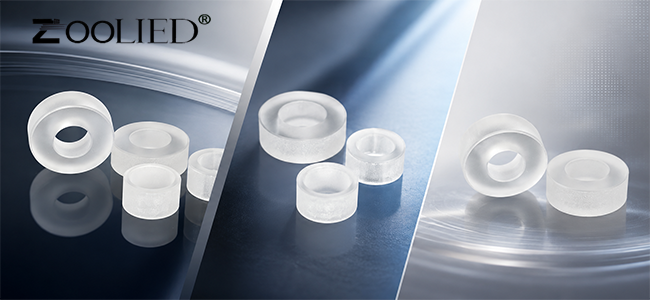
When many people first pick up a fused silica ring, their immediate reaction is: isn't this just a circular disc with a hole in the middle? Indeed, the structure of a fused silica ring is simple—a round fused silica disc with a hole bored through its center. But it is precisely this "hole" that makes its processing far more difficult than that of an ordinary fused silica flat plate.
In traditional processes, machining a ring-shaped component from a solid fused silica blank typically requires two steps: first drilling a hole, and then cutting away the excess material using wire EDM (or wire sawing). The problem lies in the drilling step—while fused silica has high hardness (Mohs hardness 7), it is extremely brittle, with tensile strength far lower than compressive strength. During drilling, the localized pressure exerted by the drill bit tends to propagate, causing cracks at the hole edges or even complete fracture of the disc.
In other words, the success or failure of one hole determines the fate of the entire ring.
The raw material for fused silica rings is high-purity silicon dioxide (SiO₂), with purity typically required to be above 99.99%. Why is purity so critical? Because in semiconductor and optical applications, impurities can cause fatal issues:
The requirement for high-temperature resistance adds another layer of difficulty. Fused silica rings are often used in high-temperature environments of 1100–1200°C, with a softening point above 1730°C. This means that the blank must maintain extremely high dimensional stability throughout processing—its extremely low coefficient of thermal expansion (approximately 5×10⁻⁷/°C) is an advantage, but if localized overheating occurs during drilling or grinding, even minor thermal stresses can evolve into micro-cracks, ultimately leading to part rejection.
Why Does the Blank Stage Matter?
Many people assume that a "blank" is merely a rough semi-finished product not worth mentioning. In reality, however, the quality of the blank determines the ceiling of the finished product.
In the typical processing workflow for fused silica rings, the general sequence is: cutting the fused silica raw material → rough grinding → drilling → fine grinding → polishing → inspection. The drilling step is placed after rough grinding and before fine grinding.
If the blank stage is not strictly controlled:
A qualified fused silica ring blank must simultaneously meet multiple requirements: high purity, bubble-free, precise dimensions, and defect-free hole edges.
How to Solve the "Drilling Difficulty"?
To address the fragility of fused silica during drilling, Zoolied already has mature process solutions:
Conclusion
High-temperature resistant, high-purity fused silica ring blanks may seem simple at first glance, but they are actually extremely challenging to produce. That "hole" is not just a geometric feature of the part—it is the core challenge of the manufacturing process.
The next time you hold a fused silica ring blank, take a closer look. Behind that neatly formed circular hole lies a synergy of materials science, precision machining, and quality control systems. For semiconductor equipment, fiber lasers, or aerospace optical systems, whether that hole is round enough and smooth enough directly affects the reliability of the entire system.
Today, we are not going to discuss grand application stories. Instead, we will focus on one specific manufacturing step: drilling the blank.
Why "Drill a Hole"?
When many people first pick up a fused silica ring, their immediate reaction is: isn't this just a circular disc with a hole in the middle? Indeed, the structure of a fused silica ring is simple—a round fused silica disc with a hole bored through its center. But it is precisely this "hole" that makes its processing far more difficult than that of an ordinary fused silica flat plate.
In traditional processes, machining a ring-shaped component from a solid fused silica blank typically requires two steps: first drilling a hole, and then cutting away the excess material using wire EDM (or wire sawing). The problem lies in the drilling step—while fused silica has high hardness (Mohs hardness 7), it is extremely brittle, with tensile strength far lower than compressive strength. During drilling, the localized pressure exerted by the drill bit tends to propagate, causing cracks at the hole edges or even complete fracture of the disc.
In other words, the success or failure of one hole determines the fate of the entire ring.
The raw material for fused silica rings is high-purity silicon dioxide (SiO₂), with purity typically required to be above 99.99%. Why is purity so critical? Because in semiconductor and optical applications, impurities can cause fatal issues:
- Metallic impurities (such as Al, Fe, Na) can diffuse into surrounding media at high temperatures, contaminating wafers or optical components
- Excessively high hydroxyl (OH⁻) content increases infrared absorption, compromising optical transmittance
- Microscopic defects such as bubbles and striae become stress concentration points, making the ring more prone to cracking during drilling
The requirement for high-temperature resistance adds another layer of difficulty. Fused silica rings are often used in high-temperature environments of 1100–1200°C, with a softening point above 1730°C. This means that the blank must maintain extremely high dimensional stability throughout processing—its extremely low coefficient of thermal expansion (approximately 5×10⁻⁷/°C) is an advantage, but if localized overheating occurs during drilling or grinding, even minor thermal stresses can evolve into micro-cracks, ultimately leading to part rejection.
Why Does the Blank Stage Matter?
Many people assume that a "blank" is merely a rough semi-finished product not worth mentioning. In reality, however, the quality of the blank determines the ceiling of the finished product.
In the typical processing workflow for fused silica rings, the general sequence is: cutting the fused silica raw material → rough grinding → drilling → fine grinding → polishing → inspection. The drilling step is placed after rough grinding and before fine grinding.
If the blank stage is not strictly controlled:
- Hole dimensional accuracy cannot be guaranteed: Subsequent fine grinding and polishing can improve surface roughness, but cannot "correct" positional deviation of the hole
- Stress concentration at the inner hole edge: Micro-cracks generated after drilling, if not completely removed during fine grinding, can propagate into through-cracks during high-temperature service
- Loss of concentricity: Poor coaxiality between the outer diameter and the inner hole can cause dynamic imbalance when the ring rotates or is installed
A qualified fused silica ring blank must simultaneously meet multiple requirements: high purity, bubble-free, precise dimensions, and defect-free hole edges.
How to Solve the "Drilling Difficulty"?
To address the fragility of fused silica during drilling, Zoolied already has mature process solutions:
- Use of annular (hollow) drill bits: Reduces contact area and minimizes localized pressure concentration
- Adequate cooling and lubricating fluid: The slurry simultaneously provides cooling and lubrication, reducing frictional heat and preventing thermal deformation
- Drilling before wire cutting: After drilling, a wire saw is used to cut away the non-ring area along the hole edge, reducing the risk of whole-blank fracture
- Step-by-step grinding: Progressing from rough grinding (large-grit slurry) to fine grinding (small-grit slurry) gradually improves surface quality, avoiding excessive material removal in a single pass
Conclusion
High-temperature resistant, high-purity fused silica ring blanks may seem simple at first glance, but they are actually extremely challenging to produce. That "hole" is not just a geometric feature of the part—it is the core challenge of the manufacturing process.
The next time you hold a fused silica ring blank, take a closer look. Behind that neatly formed circular hole lies a synergy of materials science, precision machining, and quality control systems. For semiconductor equipment, fiber lasers, or aerospace optical systems, whether that hole is round enough and smooth enough directly affects the reliability of the entire system.