What factors determine the shape of an optical window?
2026-7-7
1. Direct Conclusion
Circular windows are more widely used in optical systems. This preference is not driven by optical performance—both circular and rectangular windows can achieve essentially identical transmitted beam quality—but rather by the fact that circular windows offer lower overall cost and more mature processing techniques across four key aspects: fabrication, inspection, sealing, and alignment.
General rule: Use circular unless rectangular is functionally required. Rectangular windows should only be chosen when they are the only viable solution for specific applications, such as line-scan cameras, rectangular sensors, or slit beam paths.
2. Advantages of Circular Windows
2.1 Mature Processing Technology
Circular windows offer two inherent advantages in fabrication:
First, rotational symmetry. During polishing, the circular workpiece can rotate uniformly around its central axis. The relative motion trajectory between the polishing pad and the workpiece surface evenly covers the entire surface area, resulting in rapid surface convergence and easy achievement of high surface accuracy (PV value). A conventional circular window can stably achieve surface parameters of λ/4~λ/10@633nm.
Second, convenient inspection. Interference inspection of a circular window does not require special fixtures. The window is placed in the test optical path of a standard planar interferometer, forming equal-thickness interference fringes with a standard reference plane mirror. Surface data can be directly read, resulting in high inspection efficiency and low cost.
2.2 Simple and Reliable Sealing Structure
When used with O-ring seals, circular windows benefit from highly standardized sealing designs, low tooling costs, and excellent sealing reliability. In applications requiring pressure differentials or water resistance—such as vacuum chambers, underwater equipment, and aircraft cabins—circular windows are the preferred choice.
3. Disadvantages of Rectangular Windows
3.1 Fabrication Challenges
Rectangular windows present three primary issues:
Edge effects. During polishing, the motion at the four corners of a rectangular workpiece differs from that at the center, resulting in non-uniform material removal rates. This leads to "edge roll-off" or "edge rise" concentrated near the corner regions, where surface figure errors are most pronounced.
Difficulties in inspection. Rectangular windows cannot be directly tested using standard circular reference flats. They require either custom-manufactured reference optics matched to the window dimensions or sub-aperture stitching interferometry—both of which increase inspection cost and lead time.
Stress concentration. Sharp corners are prone to stress concentration during mounting or thermal cycling, which can lead to window fracture or localized stress-induced birefringence.
3.2 Practical Handling Requirements
The four corners of rectangular windows should be chamfered (C-chamfer or R-chamfer, recommended ≥ 2mm). This is not merely aesthetic—sharp corners are highly susceptible to edge chipping during handling and installation. Proper chamfering significantly reduces the scrap rate.
4. Quantitative Comparison
5. In Which Scenarios Are Rectangular Windows Still Preferred?
Given the significant overall advantages of circular windows, why do rectangular windows still exist? The core reason is: form-factor constraints imposed by the system's spatial layout.
6. Selection Decision Flowchart
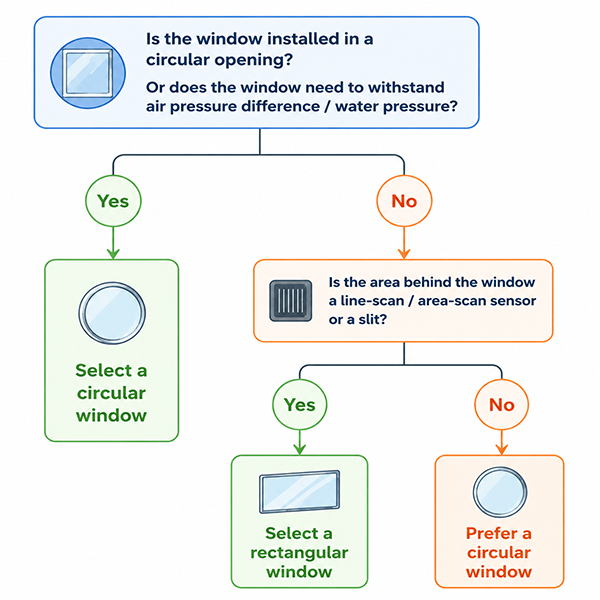
General Rule: Circular windows are the preferred choice unless a rectangular form factor is functionally required. Rectangular windows should be selected only when they are the sole viable solution for the application—such as matching line-scan cameras, rectangular sensors, or slit beam paths.
7. Special Cases – Pre-Order Consultation Required
Please contact Zoolied before placing an order if any of the following conditions apply:
Rectangular window aspect ratio > 3:1 – Edge effects become significantly more pronounced, making surface figure control increasingly difficult.
Rectangular window thickness < 3mm with side length > 100mm – Thin plates are prone to deformation; surface figure may differ significantly across fabrication, inspection, and mounting stages.
Rectangular window subject to pressure differential – Finite element mechanical simulation is required to verify thickness adequacy, preventing deformation or fracture due to insufficient thickness. The design and mounting configuration must also accommodate the bezel/retaining ring structure and O‑ring installation clearance.
Circular windows are more widely used in optical systems. This preference is not driven by optical performance—both circular and rectangular windows can achieve essentially identical transmitted beam quality—but rather by the fact that circular windows offer lower overall cost and more mature processing techniques across four key aspects: fabrication, inspection, sealing, and alignment.
General rule: Use circular unless rectangular is functionally required. Rectangular windows should only be chosen when they are the only viable solution for specific applications, such as line-scan cameras, rectangular sensors, or slit beam paths.
2. Advantages of Circular Windows
2.1 Mature Processing Technology
Circular windows offer two inherent advantages in fabrication:
First, rotational symmetry. During polishing, the circular workpiece can rotate uniformly around its central axis. The relative motion trajectory between the polishing pad and the workpiece surface evenly covers the entire surface area, resulting in rapid surface convergence and easy achievement of high surface accuracy (PV value). A conventional circular window can stably achieve surface parameters of λ/4~λ/10@633nm.
Second, convenient inspection. Interference inspection of a circular window does not require special fixtures. The window is placed in the test optical path of a standard planar interferometer, forming equal-thickness interference fringes with a standard reference plane mirror. Surface data can be directly read, resulting in high inspection efficiency and low cost.
2.2 Simple and Reliable Sealing Structure
When used with O-ring seals, circular windows benefit from highly standardized sealing designs, low tooling costs, and excellent sealing reliability. In applications requiring pressure differentials or water resistance—such as vacuum chambers, underwater equipment, and aircraft cabins—circular windows are the preferred choice.
3. Disadvantages of Rectangular Windows
3.1 Fabrication Challenges
Rectangular windows present three primary issues:
Edge effects. During polishing, the motion at the four corners of a rectangular workpiece differs from that at the center, resulting in non-uniform material removal rates. This leads to "edge roll-off" or "edge rise" concentrated near the corner regions, where surface figure errors are most pronounced.
Difficulties in inspection. Rectangular windows cannot be directly tested using standard circular reference flats. They require either custom-manufactured reference optics matched to the window dimensions or sub-aperture stitching interferometry—both of which increase inspection cost and lead time.
Stress concentration. Sharp corners are prone to stress concentration during mounting or thermal cycling, which can lead to window fracture or localized stress-induced birefringence.
3.2 Practical Handling Requirements
The four corners of rectangular windows should be chamfered (C-chamfer or R-chamfer, recommended ≥ 2mm). This is not merely aesthetic—sharp corners are highly susceptible to edge chipping during handling and installation. Proper chamfering significantly reduces the scrap rate.
4. Quantitative Comparison
|
Comparison Item |
Circular Window |
Rectangular Window (with Chamfer) |
|
Surface Figure Accuracy (PV, Typical Level) for Equivalent Aperture Size |
λ/10 |
λ/4 ~ λ/6 |
|
Fabrication Cost for Equivalent Surface Figure Accuracy |
Baseline (1×) |
~1.5× – 1.7× |
|
Interferometric Inspection Complexity |
Direct inspection, ~30 min completion |
Requires sub-aperture stitching, ~3–5 hours |
|
Sealing Structure Cost |
Low (standardized O-ring) |
Medium–High (custom gaskets or custom-profile seals required) |
|
Space Utilization |
Low (circular envelope occupies rectangular footprint) |
High (matches sensor or slit geometry) |
|
Alignment/Direction Requirements |
No preferred orientation; can be mounted at any angle |
Orientation-sensitive (must align with rectangular sensor or slit) |
5. In Which Scenarios Are Rectangular Windows Still Preferred?
Given the significant overall advantages of circular windows, why do rectangular windows still exist? The core reason is: form-factor constraints imposed by the system's spatial layout.
|
Scene |
Reason |
Typical Applications |
|
In front of line-scan or area-scan sensors |
The window must closely match the rectangular sensor active area; a circular envelope wastes valuable space |
Industrial cameras, spectrometers |
|
Entrance/exit of slit beam paths |
The beam itself is slit-shaped; rectangular windows provide a better geometric match |
Spectrometer slit protection windows |
|
Restricted panel openings |
The equipment panel can only accommodate rectangular mounting cutouts |
Airborne or vehicle-mounted compact equipment |
|
Array configurations |
Multiple windows arranged side-by-side; rectangles can be tiled seamlessly, while circles leave gaps between them |
Multi-channel detector arrays |
6. Selection Decision Flowchart
General Rule: Circular windows are the preferred choice unless a rectangular form factor is functionally required. Rectangular windows should be selected only when they are the sole viable solution for the application—such as matching line-scan cameras, rectangular sensors, or slit beam paths.
7. Special Cases – Pre-Order Consultation Required
Please contact Zoolied before placing an order if any of the following conditions apply:
Rectangular window aspect ratio > 3:1 – Edge effects become significantly more pronounced, making surface figure control increasingly difficult.
Rectangular window thickness < 3mm with side length > 100mm – Thin plates are prone to deformation; surface figure may differ significantly across fabrication, inspection, and mounting stages.
Rectangular window subject to pressure differential – Finite element mechanical simulation is required to verify thickness adequacy, preventing deformation or fracture due to insufficient thickness. The design and mounting configuration must also accommodate the bezel/retaining ring structure and O‑ring installation clearance.