H-K9L(N-BK7) Step Window: Precision Optical Component in Spectrometers
2025-12-4
In the optical system of a spectrometer, window components are far from simple transparent barriers. Their material properties and geometric design directly impact light transmission quality and the system's measurement accuracy. The H-K9L (N-BK7)step window, as a specially configured optical component, is specifically engineered to meet the unique and demanding technical requirements of spectral analysis. It plays an irreplaceable role in enhancing instrument performance.
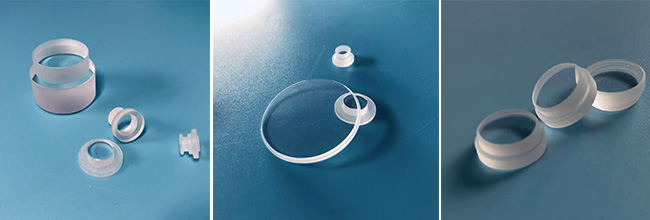
H-K9L is a crown glass type specified in China's optical glass standards, where the “H” in its designation typically denotes higher uniformity and consistency. It exhibits outstanding optical properties: high transmittance across the visible to near-infrared spectrum (approximately 350nm-2.0μm), excellent chemical stability, and moderate hardness. Compared to standard K9 glass, H-K9L undergoes stricter control over refractive index uniformity, internal impurities, and bubble content. This ensures it introduces no additional stray light or wavefront distortion when used as a spectral window, providing a pristine “optical gateway” for precise spectral measurements.
Core Function: Precision Step Design
Built-in Reference & Self-Calibration: This is the fundamental purpose of step windows. The optical path traverses different thickness zones within the window. The H-K9L material itself, with its known step thicknesses, generates specific interference fringes or absorption features in the spectrum. By rapidly switching the measurement path through different steps or utilizing dual-path simultaneous measurement, the instrument employs these known signals as real-time internal standards. This automatically compensates for baseline shifts caused by environmental temperature, pressure fluctuations, or light source drift, significantly enhancing long-term measurement stability and repeatability.
Suppression of Parasitic Interference: In long-wavelength measurements like infrared, parallel-plane windows themselves act like Fabry-Perot gratings, generating unwanted periodic interference fringes that superimpose on sample spectra as interference. The non-uniform thickness design of stepped windows disrupts the spatial consistency of these coherent conditions, effectively smoothing and suppressing such parasitic interference to yield cleaner, more authentic spectral backgrounds.
Enabling Multi-Path Integration and Spatial Encoding: In compact or specialized spectrometer designs, a single stepped window can serve multiple independent optical channels. Different thicknesses of the stepped regions can correspond to distinct measurement points on the sample or separate reference optical paths. This achieves functional integration and spatial multiplexing of optical components, simplifying system architecture.
Process Challenges and Application Fields
The fabrication of H-K9L stepped windows exemplifies precision optical machining. Each step's thickness tolerance must be achieved at the micrometer or even submicrometer level. All optical surfaces require high surface finish (typically better than λ/4) and are coated with broadband anti-reflection coatings to minimize reflection losses. Its applications are primarily concentrated in fields demanding exceptional stability and precision, such as non-dispersive infrared gas analyzers for environmental monitoring, industrial process online laser spectrometers, and certain high-precision laboratory Fourier Transform Infrared (FTIR) spectrometers.
The H-K9L step window integrates the exceptional properties of fundamental optical materials with ingenious mechanical design, transforming it from a passive light-transmitting “window” into an “intelligent component” that actively participates in spectral calibration and quality control. Though unassuming, its precision physical structure resolves core challenges like drift and interference encountered in practical spectrometer applications, making it a key enabling technology for achieving high precision and reliability in spectral analysis. We can manufacture step windows in various specifications per customer requirements. Inquiries are welcome.
Core Function: Precision Step Design
Built-in Reference & Self-Calibration: This is the fundamental purpose of step windows. The optical path traverses different thickness zones within the window. The H-K9L material itself, with its known step thicknesses, generates specific interference fringes or absorption features in the spectrum. By rapidly switching the measurement path through different steps or utilizing dual-path simultaneous measurement, the instrument employs these known signals as real-time internal standards. This automatically compensates for baseline shifts caused by environmental temperature, pressure fluctuations, or light source drift, significantly enhancing long-term measurement stability and repeatability.
Suppression of Parasitic Interference: In long-wavelength measurements like infrared, parallel-plane windows themselves act like Fabry-Perot gratings, generating unwanted periodic interference fringes that superimpose on sample spectra as interference. The non-uniform thickness design of stepped windows disrupts the spatial consistency of these coherent conditions, effectively smoothing and suppressing such parasitic interference to yield cleaner, more authentic spectral backgrounds.
Enabling Multi-Path Integration and Spatial Encoding: In compact or specialized spectrometer designs, a single stepped window can serve multiple independent optical channels. Different thicknesses of the stepped regions can correspond to distinct measurement points on the sample or separate reference optical paths. This achieves functional integration and spatial multiplexing of optical components, simplifying system architecture.
Process Challenges and Application Fields
The fabrication of H-K9L stepped windows exemplifies precision optical machining. Each step's thickness tolerance must be achieved at the micrometer or even submicrometer level. All optical surfaces require high surface finish (typically better than λ/4) and are coated with broadband anti-reflection coatings to minimize reflection losses. Its applications are primarily concentrated in fields demanding exceptional stability and precision, such as non-dispersive infrared gas analyzers for environmental monitoring, industrial process online laser spectrometers, and certain high-precision laboratory Fourier Transform Infrared (FTIR) spectrometers.
The H-K9L step window integrates the exceptional properties of fundamental optical materials with ingenious mechanical design, transforming it from a passive light-transmitting “window” into an “intelligent component” that actively participates in spectral calibration and quality control. Though unassuming, its precision physical structure resolves core challenges like drift and interference encountered in practical spectrometer applications, making it a key enabling technology for achieving high precision and reliability in spectral analysis. We can manufacture step windows in various specifications per customer requirements. Inquiries are welcome.