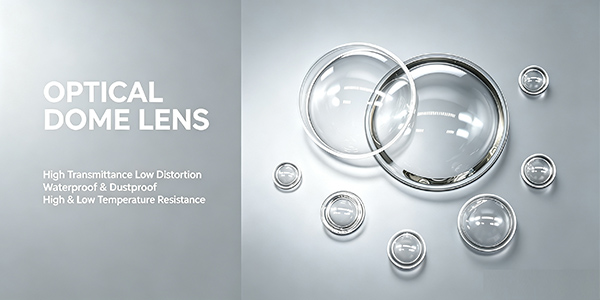
I. Core Characteristics and Key Performance Indicators
The technical requirements for optical domes encompass three dimensions: optical performance, geometric accuracy and environmental adaptability.
In terms of optical performance, light transmittance is the primary indicator. Different substrate materials correspond to different operating wavelength bands: K9 optical glass exhibits excellent transmittance in the 350 nm–2000 nm band and is suitable for visible light and near-infrared applications; fused quartz (such as JGS1), owing to its low coefficient of thermal expansion and high-temperature resistance, is the preferred choice for the ultraviolet spectrum and high-power laser systems; sapphire (Mohs hardness 9), with its broad-band transmission and high impact resistance, is commonly used in military and aerospace applications. Coating technology can further enhance performance—anti-reflection coatings can increase two-sided transmittance to over 97 per cent, whilst specialised coatings such as hydrophobic and conductive coatings meet requirements for self-cleaning or electromagnetic shielding.
In terms of geometric accuracy, the core challenge for spherical hoods lies in controlling ‘concentricity’. The inner and outer centres of an ideal spherical hood must coincide precisely to ensure consistent thickness at every point and avoid introducing additional aberrations. Industry standards specify clear grading criteria for surface defects, surface profile accuracy (e.g. local ΔN < 10 at 633 nm), wall thickness uniformity and eccentricity; for precision-grade products, surface roughness can be controlled to below 0.5 nm. Furthermore, environmental adaptability indicators such as high- and low-temperature cycling and salt spray corrosion resistance must also be taken into account.
II. Selection Criteria and Considerations
The selection process should follow a progressive logic of ‘application scenario – performance requirements – cost constraints’.
Select the substrate based on the operating wavelength band: fused quartz is preferred for the ultraviolet band; for the visible and near-infrared bands, optical glasses such as K9 and BK7 are more cost-effective; whilst for the infrared band, materials such as silicon, germanium or zinc sulphide should be considered.
Determine the strength grade based on the mechanical environment: high-speed aircraft or deep-sea equipment require sapphire or thick-walled spherical domes (recommended thickness ≥ 4 mm), with particular attention to impact resistance parameters; for routine outdoor observations, lower-cost polymeric materials such as PC or PMMA may be selected.
Match the accuracy grade to the budget: High-resolution imaging systems require precision-grade products with a surface form accuracy of λ/4 or better and a surface finish of 20/10; for non-imaging sensor applications, accuracy requirements may be appropriately relaxed.
Consider customisation capabilities: Most applications require tailored coating designs and specific dimensions (diameter ranges typically from 10 mm to 300 mm); suppliers’ technical proficiency in concentricity control, edge finishing and batch consistency should be assessed.
In summary, the selection of optical domes involves a comprehensive balancing of optical design, mechanical strength and environmental engineering. Clearly defining the system’s operating wavelength band, operating environment and aberration tolerances is a key prerequisite for making an informed selection.