Biochemical Analyzer Filter Selection: What's the Difference Between 10 nm and 25 nm Bandwidths?
2026-11-10
In the selection of filters for biochemical analyzers, the Full Width at Half Maximum (FWHM) is a parameter that is often oversimplified. Procurement specialists and R&D engineers frequently ask: How big is the difference between 10 nm and 25 nm? Can we use a 25 nm filter as a substitute for a 10 nm one to cut costs or boost signal strength?
To get straight to the point: In mainstream biochemical analyzer applications, 10 nm is the proven default, while 25 nm is not. The gap between the two isn't just a simple "high versus low precision" ranking. It's an engineering trade-off between signal-to-noise ratio (SNR) and signal intensity. And in the specific context of biochemical testing, the scales tip decisively in favor of the narrower bandwidth.
1. Industry Baseline: What Bandwidths Are Biochemical Analyzers Actually Using?
Looking at the standard product specifications from mainstream filter suppliers, the dominant bandwidth for biochemical analyzer filters is clustered around 8–10 nm, not 25 nm. Most standard biochemical filters offer explicit half-bandwidth options of 8 nm or 10 nm, with blocking depths reaching OD5 or even OD6, covering the common biochemical wavelengths from 340 nm to 770 nm.
A 25 nm bandwidth is uncommon among standard biochemical products. It appears more frequently in scenarios demanding extremely high optical throughput but with relatively relaxed requirements for spectral purity, or as a compromise for cost-sensitive solutions. However, under the absorbance measurement logic of biochemical testing, the problems introduced by relaxing the bandwidth to 25 nm often outweigh the benefits.
2. The Logic of 10 nm: Keeping Interference Out of the Passband
The core of biochemical analysis is absorbance measurement. Light at a specific wavelength passes through the reaction solution, is absorbed by the target substance, and the detector measures the change in transmitted light. If the filter's passband is too wide, it doesn't just let the target wavelength through; it also allows stray light from adjacent spectral bands to enter. This stray light is not absorbed by the target substance to the same degree, yet it is picked up by the detector alongside the signal. This directly dilutes the absorbance signal, leading to low readings and degraded linearity.
The narrower the spectral half-bandwidth, the higher the monochromatic purity—this is a fundamental constraint of photometric detection. Widening the bandwidth from 10 nm to 25 nm more than doubles the wavelength range covered by the passband. In assays with sharp absorption peaks, this gap is enough for stray light from the edge of the passband to bleed in, disrupting the linear relationship described by the Beer-Lambert law.
This is precisely why high-SNR biochemical filters push the background down to OD5 or even OD6 while simultaneously tightening the bandwidth to 8–10 nm. The two are complementary: the narrower the passband, the deeper the blocking, and the "cleaner" the monochromatic light. It's not that a narrower half-bandwidth is always better, but a wider passband allows a broader spectrum of light into the system—a factor that warrants caution in biochemical assays requiring high specificity.
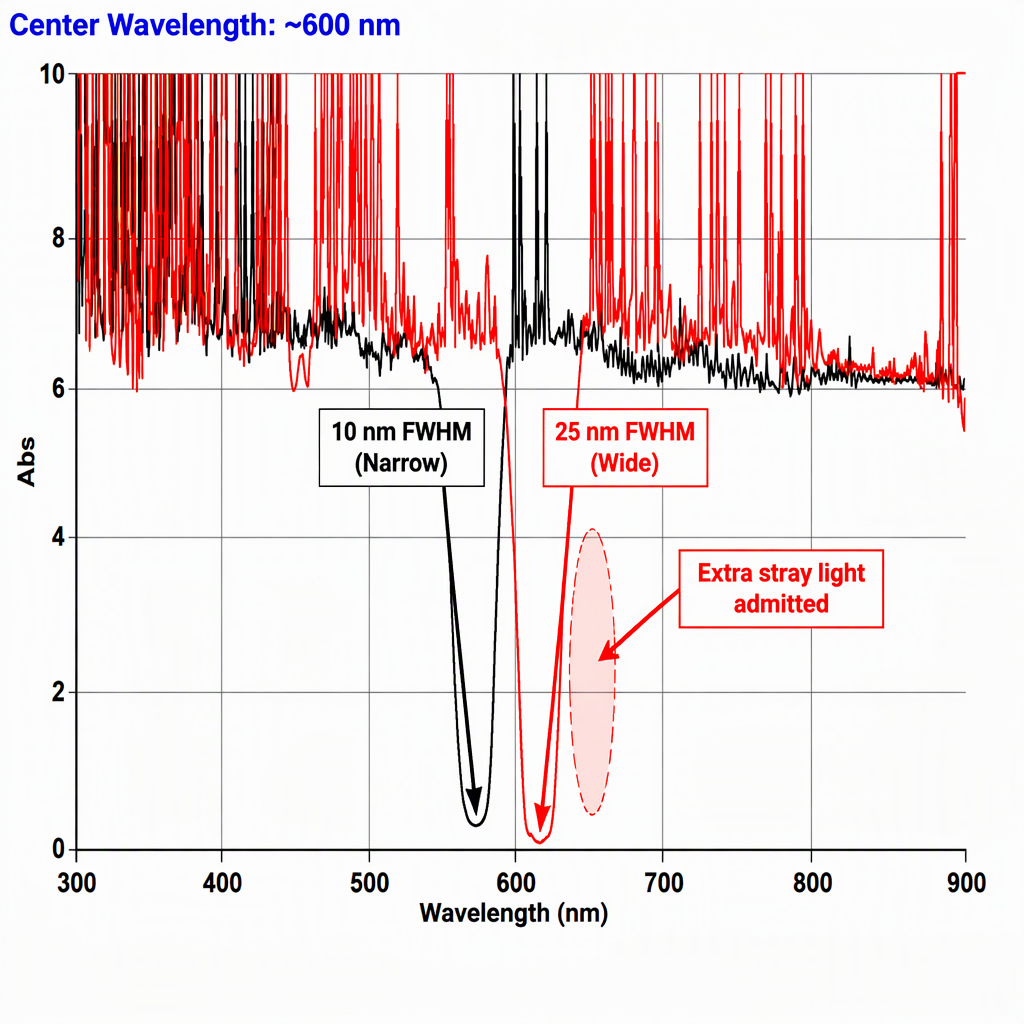 Figure 1: Spectral response comparison of 10 nm vs. 25 nm filters.
Both filters target the ~600 nm channel. The black curve (10 nm half-bandwidth) effectively blocks adjacent wavelengths, while the red curve (25 nm half-bandwidth) has a broader passband. The area circled in red dashed lines shows exactly where the wider filter admits "extra stray light." This increases the risk of interference in absorbance measurements for biochemical analysis. (Note: In this absorbance scan, the "valleys" represent the high-transmittance passband, while the upper region is the blocking zone.)
3. The Cost of 25 nm: Stronger Signal, Lower Purity
The most direct benefit of relaxing the bandwidth to 25 nm is that more optical energy passes through the filter. Biochemical analyzers typically use halogen lamps as a light source, which offer a broad spectrum but limited energy density. The narrower the passband, the weaker the light reaching the detector. For assays with inherently low absorbance, or instruments with aging light sources and standard-sensitivity detectors, a wider bandwidth can indeed secure a stronger signal.
The cost is a drop in spectral purity. A 25 nm passband may cover regions outside the target absorption peak. If other substances in the reaction system absorb light in this band, interference is inevitable. Furthermore, if the filter's edge steepness cannot keep up once the passband is widened, leakage at the band edges will further degrade the SNR. If a 25 nm filter only achieves OD3 blocking, while its 10 nm counterpart reaches OD5, the additional light entering the system might just be a flood of stray light—turning "stronger signal" into "stronger noise."
4. What You Should Really Evaluate During Selection
Rather than asking "10 nm or 25 nm" in isolation, it's better to make the call based on your overall optical path and assay methodology:
First, how wide is the absorption peak of the assay? If the target substance's absorption peak is broad and there are no interfering absorption bands nearby, the risk of widening the bandwidth is relatively manageable. But if the peak is sharp with adjacent interference, 10 nm is your baseline.
Second, is there enough energy budget for the light source and detector? If the instrument's signal is already weak at the longer wavelengths, widening the passband to 25 nm is a crude way to compensate. A more robust approach is to use an "energy-matched" filter designed to spectrally shape the output based on the response curve of the halogen lamp and silicon photodetector, rather than simply widening the bandwidth.
Third, can the blocking depth keep up? Widening the bandwidth places a heavier burden on out-of-band suppression. If a 25 nm product's blocking capability doesn't increase accordingly, the selection is invalid.
5. The Zoolied Solution
Zoolied's biochemical analyzer filter product line covers the standard detection wavelengths from the UV to the visible range. For standard biochemical channels, an 8–10 nm half-bandwidth paired with deep blocking is the industry-proven starting point.
If your instrument's optical path has specific energy-matching requirements, or if your assay demands a customized bandwidth, the selection logic should be: first confirm the absorption characteristics and interference profile of the target wavelength, then decide whether to maintain the 10 nm baseline or make slight adjustments, while ensuring the blocking depth aligns with your bandwidth choice. A 25nm filter isn't impossible to manufacture, but it shouldn't be the default choice for biochemical analyzers.
Zoolied Inc. | Precision Optics & Laser Components Supplier
Changchun, China (Liandong U Valley Automotive Research & Innovation Park)
📧 sales@zoolied.com | 📱 +86 17743480638
🌐 www.zoolied.com
To get straight to the point: In mainstream biochemical analyzer applications, 10 nm is the proven default, while 25 nm is not. The gap between the two isn't just a simple "high versus low precision" ranking. It's an engineering trade-off between signal-to-noise ratio (SNR) and signal intensity. And in the specific context of biochemical testing, the scales tip decisively in favor of the narrower bandwidth.
1. Industry Baseline: What Bandwidths Are Biochemical Analyzers Actually Using?
Looking at the standard product specifications from mainstream filter suppliers, the dominant bandwidth for biochemical analyzer filters is clustered around 8–10 nm, not 25 nm. Most standard biochemical filters offer explicit half-bandwidth options of 8 nm or 10 nm, with blocking depths reaching OD5 or even OD6, covering the common biochemical wavelengths from 340 nm to 770 nm.
A 25 nm bandwidth is uncommon among standard biochemical products. It appears more frequently in scenarios demanding extremely high optical throughput but with relatively relaxed requirements for spectral purity, or as a compromise for cost-sensitive solutions. However, under the absorbance measurement logic of biochemical testing, the problems introduced by relaxing the bandwidth to 25 nm often outweigh the benefits.
2. The Logic of 10 nm: Keeping Interference Out of the Passband
The core of biochemical analysis is absorbance measurement. Light at a specific wavelength passes through the reaction solution, is absorbed by the target substance, and the detector measures the change in transmitted light. If the filter's passband is too wide, it doesn't just let the target wavelength through; it also allows stray light from adjacent spectral bands to enter. This stray light is not absorbed by the target substance to the same degree, yet it is picked up by the detector alongside the signal. This directly dilutes the absorbance signal, leading to low readings and degraded linearity.
The narrower the spectral half-bandwidth, the higher the monochromatic purity—this is a fundamental constraint of photometric detection. Widening the bandwidth from 10 nm to 25 nm more than doubles the wavelength range covered by the passband. In assays with sharp absorption peaks, this gap is enough for stray light from the edge of the passband to bleed in, disrupting the linear relationship described by the Beer-Lambert law.
This is precisely why high-SNR biochemical filters push the background down to OD5 or even OD6 while simultaneously tightening the bandwidth to 8–10 nm. The two are complementary: the narrower the passband, the deeper the blocking, and the "cleaner" the monochromatic light. It's not that a narrower half-bandwidth is always better, but a wider passband allows a broader spectrum of light into the system—a factor that warrants caution in biochemical assays requiring high specificity.
Both filters target the ~600 nm channel. The black curve (10 nm half-bandwidth) effectively blocks adjacent wavelengths, while the red curve (25 nm half-bandwidth) has a broader passband. The area circled in red dashed lines shows exactly where the wider filter admits "extra stray light." This increases the risk of interference in absorbance measurements for biochemical analysis. (Note: In this absorbance scan, the "valleys" represent the high-transmittance passband, while the upper region is the blocking zone.)
3. The Cost of 25 nm: Stronger Signal, Lower Purity
The most direct benefit of relaxing the bandwidth to 25 nm is that more optical energy passes through the filter. Biochemical analyzers typically use halogen lamps as a light source, which offer a broad spectrum but limited energy density. The narrower the passband, the weaker the light reaching the detector. For assays with inherently low absorbance, or instruments with aging light sources and standard-sensitivity detectors, a wider bandwidth can indeed secure a stronger signal.
The cost is a drop in spectral purity. A 25 nm passband may cover regions outside the target absorption peak. If other substances in the reaction system absorb light in this band, interference is inevitable. Furthermore, if the filter's edge steepness cannot keep up once the passband is widened, leakage at the band edges will further degrade the SNR. If a 25 nm filter only achieves OD3 blocking, while its 10 nm counterpart reaches OD5, the additional light entering the system might just be a flood of stray light—turning "stronger signal" into "stronger noise."
4. What You Should Really Evaluate During Selection
Rather than asking "10 nm or 25 nm" in isolation, it's better to make the call based on your overall optical path and assay methodology:
First, how wide is the absorption peak of the assay? If the target substance's absorption peak is broad and there are no interfering absorption bands nearby, the risk of widening the bandwidth is relatively manageable. But if the peak is sharp with adjacent interference, 10 nm is your baseline.
Second, is there enough energy budget for the light source and detector? If the instrument's signal is already weak at the longer wavelengths, widening the passband to 25 nm is a crude way to compensate. A more robust approach is to use an "energy-matched" filter designed to spectrally shape the output based on the response curve of the halogen lamp and silicon photodetector, rather than simply widening the bandwidth.
Third, can the blocking depth keep up? Widening the bandwidth places a heavier burden on out-of-band suppression. If a 25 nm product's blocking capability doesn't increase accordingly, the selection is invalid.
5. The Zoolied Solution
Zoolied's biochemical analyzer filter product line covers the standard detection wavelengths from the UV to the visible range. For standard biochemical channels, an 8–10 nm half-bandwidth paired with deep blocking is the industry-proven starting point.
If your instrument's optical path has specific energy-matching requirements, or if your assay demands a customized bandwidth, the selection logic should be: first confirm the absorption characteristics and interference profile of the target wavelength, then decide whether to maintain the 10 nm baseline or make slight adjustments, while ensuring the blocking depth aligns with your bandwidth choice. A 25nm filter isn't impossible to manufacture, but it shouldn't be the default choice for biochemical analyzers.
Zoolied Inc. | Precision Optics & Laser Components Supplier
Changchun, China (Liandong U Valley Automotive Research & Innovation Park)
📧 sales@zoolied.com | 📱 +86 17743480638
🌐 www.zoolied.com