Choosing a Mirror Coating: Metal or Dielectric? Three Criteria to Decide
2026-10-21
In optical system construction, the coating choice for a mirror often determines the efficiency, stability, and maintenance cost of the entire optical path. At Zoolied, we frequently encounter a question from customers: when high reflectivity is required in both cases, why do some scenarios call for metal coatings while others insist on dielectric coatings?
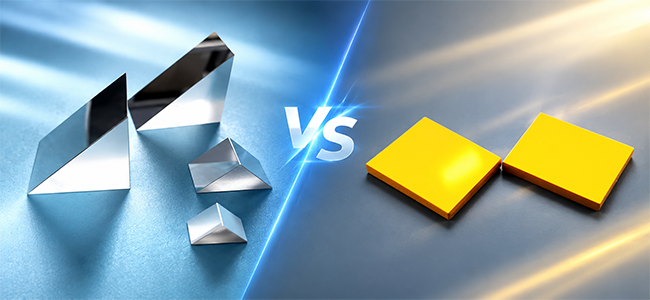
1. The Essential Difference: Absorption vs. Interference
Metal coatings rely on the free electrons on a metal surface to reflect light. Aluminum, silver, and gold all provide considerable reflectivity across a very broad spectral range, but since the metal itself is a conductor, a portion of the light energy is lost as Joule heat during reflection. This means the upper limit of a metal mirror's reflectivity is constrained by the material's intrinsic absorption, with typical values around 93%–96%, and it is very difficult to go higher.
Dielectric coatings take a completely different approach. They consist of alternating high- and low-index dielectric materials stacked in multiple layers, using multilayer interference effects to achieve reflection within a specific spectral band. Ideally, dielectric materials absorb almost no light, so a well-designed all-dielectric coating can achieve reflectivity above 99%, even approaching the theoretical limit. The trade-off is that this high reflectivity only holds within a designed spectral band; outside this window, reflectivity drops rapidly.
2. Comparison of Key Metrics
The most easily overlooked item in this table is incidence angle sensitivity. Metal mirrors used over a range of 0°–45° have essentially flat reflectivity curves, making them suitable for beam steering, illumination collimation, and similar scenarios. Dielectric mirrors, by contrast, typically have their rated parameters tied to a specific angle, such as "45° incidence"; in actual use, if the angle deviates by more than ±3°, the reflection band may shift or collapse. If your system has loose alignment tolerances or requires flexible use at multiple angles, this point deserves special attention.
3. Selection Decision: Three Questions to Set the Direction
Q1: Is your light source broadband or narrowband?
For broadband applications such as white-light illumination, multi-wavelength fluorescence detection, and infrared thermal imaging, metal coatings are almost the default choice. Aluminum coatings cover ultraviolet to near-infrared, gold coatings perform excellently in the infrared region above 2 μm, and silver coatings have higher reflectivity than aluminum in the visible region. The aluminum mirrors offered by Zoolied are standard solutions designed precisely for such broadband requirements.
Conversely, for a single laser wavelength—such as 1064 nm Nd:YAG, 532 nm frequency-doubled light, or a specific fluorescence excitation channel—a dielectric coating can achieve near-perfect reflection at that point while transmitting or absorbing out-of-band stray light, offering a clear advantage in signal-to-noise ratio.
Q2: How high is your laser power density?
Although the absorption of a metal coating is only a few percent, under high-power lasers this small absorption can be converted into considerable heat, leading to coating temperature rise, thermal distortion, or even destruction. The low-absorption characteristics of dielectric coatings make them the first choice for high-power laser systems. If your system involves milliwatt-level detection or low-power illumination, the thermal issue of metal coatings can be ignored; once you enter the watt-level and above range for continuous or pulsed lasers, dielectric coatings are almost mandatory.
Q3: What are your budget and alignment conditions?
Dielectric mirrors typically cost several times more than metal mirrors and are picky about incidence angle and polarization state. A common misconception is choosing a dielectric coating in pursuit of "maximum reflectivity," only to find that the optical path contains multiple steering mirrors at different angles, or that the angle cannot be aligned accurately during setup—in which case the actual performance may be worse than an honest metal mirror.
4. A Compromise Option: Metal-Dielectric Composite Coatings
In actual products, there is also a class of "metal + dielectric protective/enhancement layer" composite structures. A dielectric film is overlaid on the metal reflective layer, preserving the broadband characteristics of the metal while improving coating durability and even enhancing reflectivity to some degree in a designated band. Some of Zoolied's mirror products also offer protective coating options to isolate the metal layer from air contact and slow oxidation.
However, it must be made clear: a protective coating is not the same as an enhancement coating. A single-layer silicon dioxide protective film mainly addresses the oxidation and scratching issues of silver and aluminum coatings, with limited improvement in reflectivity; a multilayer dielectric enhancement coating deliberately sacrifices part of the bandwidth in exchange for performance improvement in a specific band. When selecting, it is necessary to confirm the specific coating structure with the supplier rather than just looking at the words "with protective coating."
5. Zoolied's Practical Recommendations
In the process of serving laser, medical, and instrumentation customers, Zoolied has summarized a simple decision logic:
Broadband light source, variable angles, budget-sensitive → Metal coating (aluminum for general use, silver preferred for visible, gold preferred for infrared)
Single wavelength, rigid high-reflectivity requirement, medium-to-high power laser → Dielectric coating (use strictly at the design angle and polarization state)
Broadband but humid environment or need for wipe-down maintenance → Metal coating + dielectric protective layer
If you are struggling with coating selection for a specific optical system, you are welcome to contact Zoolied's technical team. We can provide targeted recommendations based on your wavelength, angle, and power conditions.
Zoolied Inc.
Specializing in optical components and laser accessories · Mirrors / Lenses / Windows / Prisms
📧 sales@zoolied.com
🌐 www.zoolied.com
1. The Essential Difference: Absorption vs. Interference
Metal coatings rely on the free electrons on a metal surface to reflect light. Aluminum, silver, and gold all provide considerable reflectivity across a very broad spectral range, but since the metal itself is a conductor, a portion of the light energy is lost as Joule heat during reflection. This means the upper limit of a metal mirror's reflectivity is constrained by the material's intrinsic absorption, with typical values around 93%–96%, and it is very difficult to go higher.
Dielectric coatings take a completely different approach. They consist of alternating high- and low-index dielectric materials stacked in multiple layers, using multilayer interference effects to achieve reflection within a specific spectral band. Ideally, dielectric materials absorb almost no light, so a well-designed all-dielectric coating can achieve reflectivity above 99%, even approaching the theoretical limit. The trade-off is that this high reflectivity only holds within a designed spectral band; outside this window, reflectivity drops rapidly.
2. Comparison of Key Metrics
|
Comparison Dimension |
Metal Coating |
Dielectric Coating |
|
Typical Reflectivity |
93%–96% (silver higher in the visible) |
99%+ (at design wavelength) |
|
Effective Bandwidth |
Extremely broad, from visible to far infrared |
Narrow, typically tens to just over a hundred nanometers |
|
Incidence Angle Sensitivity |
Low, usable at essentially any angle |
High, reflectivity drops noticeably when deviating from design angle |
|
Polarization Effect |
Negligible |
Significant, S/P polarization separation at oblique incidence |
|
Coating Hardness |
Soft, easily scratched |
Hard, can be cleaned by wiping |
|
Laser Damage Threshold |
Relatively low (absorption leads to heat accumulation) |
High (low absorption) |
|
Cost |
Low |
High (many layers, complex process) |
The most easily overlooked item in this table is incidence angle sensitivity. Metal mirrors used over a range of 0°–45° have essentially flat reflectivity curves, making them suitable for beam steering, illumination collimation, and similar scenarios. Dielectric mirrors, by contrast, typically have their rated parameters tied to a specific angle, such as "45° incidence"; in actual use, if the angle deviates by more than ±3°, the reflection band may shift or collapse. If your system has loose alignment tolerances or requires flexible use at multiple angles, this point deserves special attention.
3. Selection Decision: Three Questions to Set the Direction
Q1: Is your light source broadband or narrowband?
For broadband applications such as white-light illumination, multi-wavelength fluorescence detection, and infrared thermal imaging, metal coatings are almost the default choice. Aluminum coatings cover ultraviolet to near-infrared, gold coatings perform excellently in the infrared region above 2 μm, and silver coatings have higher reflectivity than aluminum in the visible region. The aluminum mirrors offered by Zoolied are standard solutions designed precisely for such broadband requirements.
Conversely, for a single laser wavelength—such as 1064 nm Nd:YAG, 532 nm frequency-doubled light, or a specific fluorescence excitation channel—a dielectric coating can achieve near-perfect reflection at that point while transmitting or absorbing out-of-band stray light, offering a clear advantage in signal-to-noise ratio.
Q2: How high is your laser power density?
Although the absorption of a metal coating is only a few percent, under high-power lasers this small absorption can be converted into considerable heat, leading to coating temperature rise, thermal distortion, or even destruction. The low-absorption characteristics of dielectric coatings make them the first choice for high-power laser systems. If your system involves milliwatt-level detection or low-power illumination, the thermal issue of metal coatings can be ignored; once you enter the watt-level and above range for continuous or pulsed lasers, dielectric coatings are almost mandatory.
Q3: What are your budget and alignment conditions?
Dielectric mirrors typically cost several times more than metal mirrors and are picky about incidence angle and polarization state. A common misconception is choosing a dielectric coating in pursuit of "maximum reflectivity," only to find that the optical path contains multiple steering mirrors at different angles, or that the angle cannot be aligned accurately during setup—in which case the actual performance may be worse than an honest metal mirror.
4. A Compromise Option: Metal-Dielectric Composite Coatings
In actual products, there is also a class of "metal + dielectric protective/enhancement layer" composite structures. A dielectric film is overlaid on the metal reflective layer, preserving the broadband characteristics of the metal while improving coating durability and even enhancing reflectivity to some degree in a designated band. Some of Zoolied's mirror products also offer protective coating options to isolate the metal layer from air contact and slow oxidation.
However, it must be made clear: a protective coating is not the same as an enhancement coating. A single-layer silicon dioxide protective film mainly addresses the oxidation and scratching issues of silver and aluminum coatings, with limited improvement in reflectivity; a multilayer dielectric enhancement coating deliberately sacrifices part of the bandwidth in exchange for performance improvement in a specific band. When selecting, it is necessary to confirm the specific coating structure with the supplier rather than just looking at the words "with protective coating."
5. Zoolied's Practical Recommendations
In the process of serving laser, medical, and instrumentation customers, Zoolied has summarized a simple decision logic:
Broadband light source, variable angles, budget-sensitive → Metal coating (aluminum for general use, silver preferred for visible, gold preferred for infrared)
Single wavelength, rigid high-reflectivity requirement, medium-to-high power laser → Dielectric coating (use strictly at the design angle and polarization state)
Broadband but humid environment or need for wipe-down maintenance → Metal coating + dielectric protective layer
If you are struggling with coating selection for a specific optical system, you are welcome to contact Zoolied's technical team. We can provide targeted recommendations based on your wavelength, angle, and power conditions.
Zoolied Inc.
Specializing in optical components and laser accessories · Mirrors / Lenses / Windows / Prisms
📧 sales@zoolied.com
🌐 www.zoolied.com